
The best Linked Helper alternatives in 2026 are Cadency, HeyReach, Expandi, Dripify, Waalaxy, Meet Alfred and SalesRobot. Teams usually leave Linked Helper for three reasons: the automation runs from a desktop app on your own computer, each LinkedIn account needs its own license, and team features such as workspaces and a shared inbox sit on top of that per-license, machine-bound model rather than replacing it. Waalaxy or Dripify suit one seller on a budget, Expandi suits a cloud setup with a dedicated IP per account, and Cadency or HeyReach suit a fleet of accounts. Every price below comes from the vendor's own pages, read in October 2026.
Linked Helper is the price benchmark in this category, and none of the seven tools below beats its sticker price. What they change is where campaigns run, what a second account costs and who can see the replies. Prices for Linked Helper, SalesRobot, HeyReach, Expandi, Dripify, Waalaxy and Meet Alfred were checked on their own pages on 24 October 2026 (Waalaxy's US dollar grid was last seen on 8 October 2026), and Cadency's are as published in October 2026. Other details come from the readings of 26 September to 8 October 2026 unless a sentence dates them. Standard prices are used, not promotions.
How do the seven Linked Helper alternatives differ at a glance?
| Tool | Best for | Billing unit | Entry price, monthly billing |
|---|---|---|---|
| Cadency | Teams and agencies running many LinkedIn senders and mailboxes as one campaign | Plan plus each extra LinkedIn sender | $89 with 2 LinkedIn senders included |
| HeyReach | Agencies that want to pay per sender and move to flat bundles | Per LinkedIn sender | $79 per sender |
| Expandi | One operator or a small team that wants a dedicated country-based IP per account | Per LinkedIn account | $99 per account |
| Dripify | A solo seller who wants a simple cloud sequence builder | Per user | $79 (Pro), $99 (Advanced) |
| Waalaxy | The lowest entry price, at low volume | Per user | €39 (Pro) |
| Meet Alfred | Small teams that want LinkedIn and email together on an annual budget | Per user | $59 (Individual, LinkedIn only), $79 a seat (Teams, 3-seat minimum) |
| SalesRobot | LinkedIn plus email in one sequence, staying under a handful of accounts | Per LinkedIn account | $59 (Basic) |
An entry price usually comes with a quota, and the quota is what you actually buy, so the sections below put each tool's limit next to its price.
Why do teams outgrow Linked Helper?
Linked Helper's Local Standard plan costs $15 a month, or $99 for the year ($8.25 a month), at the rates its pricing page showed on 24 October 2026. The vendor claims more than 500,000 users on its homepage as read on 30 September 2026, and at that price the appeal is obvious. The trouble starts when one person with one account turns into a team, because three limits arrive in order.
- It runs on your computer. Linked Helper is a downloadable desktop app. Campaigns run from your machine while it is switched on, and from your own IP unless you source and configure a proxy yourself. Nothing runs in a vendor's cloud on your behalf.
- One license covers one LinkedIn account. The pricing page is explicit. You can repoint a license at another account, but you cannot run two accounts on it at the same time. Ten accounts mean ten licenses and ten separate instances to look after.
- The team layer is thin. The page lists workspaces per client, workspace roles (Owner, Admin, Member, Guest), view-only guest access for clients and a shared inbox sync, and it discounts bulk license purchases. Automatic data sharing across accounts is a cloud-storage feature, and no flat team plan is listed, so every account is still its own license and its own machine-bound instance.
The cheap tier also has ceilings of its own. Standard caps advanced actions at 20 a day and webhooks at 20 profiles a day, and it includes 620 monthly data credits against 3,100 on Pro. Pro costs $45 a month and removes the daily action caps, which is roughly where the price advantage begins to narrow. You buy Linked Helper as a solo rep at $15 and leave it when you become a team. Our wider ranking of LinkedIn automation tools shows where each alternative sits in the market.
Is running Linked Helper from your own computer a safety problem?
Start with what Linked Helper gets right. It is a desktop application, not a Chrome extension, and that matters: no code is injected into LinkedIn's pages, and extensions that modify those pages can leave a detectable footprint, as we cover in our guide to LinkedIn Chrome extensions. The vendor also says it imitates human behavior with randomized timeouts, in-page navigation and mouse movement. Those are vendor claims, but the architectural argument is a fair one.
Now the detail that is easy to miss. Linked Helper sells a "Cloud-based" edition at $29.90 a month for Standard and $59.90 for Pro. As we read the plan descriptions on 24 October 2026, that adds cloud storage: your campaign data syncs so you can reach it from several devices. The automation itself still runs from software installed on your own computer, from your own IP unless you configure a proxy. Proxy support is advertised, but buying and maintaining that proxy is your job, and running 24/7 from a stable IP means renting and looking after a VPS or proxy yourself.
Cloud platforms invert that arrangement. The LinkedIn session runs on the platform's side, from an IP assigned to your account. Expandi advertises a dedicated country-based IP and automatic profile warm-up, and Cadency gives every LinkedIn sender its own dedicated proxy, with per-sender ceilings, pacing and checkpoint handling, and nothing running from your browser.
None of this makes any tool safe in absolute terms. LinkedIn's User Agreement prohibits bots and other automated methods of accessing the service, so every tool in this guide, Linked Helper included, is an exercise in managing risk. Keep volumes inside sensible connection request limits, warm accounts up slowly, and read our breakdown of whether LinkedIn automation is safe before scaling anything.
What does each Linked Helper alternative cost on its entry plan?
All prices are monthly list prices from each vendor's own pricing page. Waalaxy's prices depend on the visitor's country, and its standard euro grid is shown.
| Tool | Entry price (monthly billing) | Annual or longer billing | Billing unit | Trial | Catch at the entry tier |
|---|---|---|---|---|---|
| Linked Helper | $15 (Local Standard) | $99 a year ($8.25 a month) | One license per LinkedIn account | 14 days | 20 advanced actions a day; runs on your computer |
| Cadency | $89 (Essential, 2 LinkedIn senders) | $62 a month | Plan plus $39 per extra sender | Free trial on Essential | Starts at $89, far above Linked Helper's $15 for one account |
| HeyReach | $79 per sender (Growth) | $64 per sender | Per LinkedIn sender, then agency bundles | 14 days, no card | Per-sender cost climbs before the $999 bundle for 25 |
| Expandi | $99 per account (Business) | $79 per account | Per LinkedIn account | 7 days | Highest per-account entry price on the list |
| Dripify | $79 (Pro) | $59 (Pro) | Per user | 7 days, no card | Pro: unlimited campaigns, up to 75 connection requests and 100+ messages a day |
| Waalaxy | €39 (Pro) | €31 quarterly, €19 yearly (Pro) | Per user | 14 days | 300 invitations a month; email sequences only on Business |
| Meet Alfred | $59 (Individual) | $35 (Individual) | Per user | Free trial, no card | Individual: LinkedIn only, does not include unlimited campaigns |
| SalesRobot | $59 (Basic) | $39 (Basic) | Per LinkedIn account | 14 days | Basic: 1 active campaign and limited quotas |
What does each option cost at 5, 25 and 50 LinkedIn accounts?
The entry price hides the number that decides this purchase: the bill across a fleet. Per-license and per-user tools inherit the same cost curve that people are leaving Linked Helper to escape. The table multiplies monthly list prices by account count, and uses each vendor's published bundle where one exists.
| Plan (monthly list prices) | 5 accounts | 25 accounts | 50 accounts |
|---|---|---|---|
| Linked Helper Local Standard ($15) | $75 | $375 | $750 |
| Linked Helper Local Pro ($45) | $225 | $1,125 | $2,250 |
| Cadency (Small Team $199 with 5 senders, Scale $699 with 20, extra senders $39 and $25) | $199 | $824 | $1,449 |
| HeyReach (Growth $79 per sender, $59 from 10; Agency plan $999 for 25 or $1,399 for 50) | $395 | $999 (Growth alone: $1,475 at $59) | $1,399 (Growth alone: $2,950 at $59) |
| Dripify Advanced ($99 per user, the tier with team management) | $495 | $2,475 | $4,950 |
| Expandi Business ($99 per account) | $495 | $2,475 | $4,950 |
| Meet Alfred Teams ($79 per seat, 3-seat minimum) | $395 | $1,975 | $3,950 |
| SalesRobot Advanced ($79 per account, with volume discounts from 11 accounts) | $395 | $1,100 | Custom quote |
| Waalaxy Pro (€39 per user) | €195 | €975 | €1,950 |
Two things stand out. First, Linked Helper Standard stays the lowest bill at every scale, without exception. What the other tools charge for is cloud execution, one shared inbox and one dashboard in place of fifty desktop instances. Second, the flat-bundle plans change the maths in the middle: at 25 accounts the $79 to $99 per-account ladders run from $1,975 to $2,475, SalesRobot's volume discount excepted at about $1,100, while a bundle costs $824 to $999. At 50 accounts HeyReach's Agency bundle is $50 below Cadency's Scale plan, but HeyReach sends no email natively, whereas Cadency's price already covers 500k emails a month and unlimited mailboxes.
Some of these figures are ceilings. Expandi's Agency plan is custom from 10 seats, Meet Alfred keeps volume pricing for its custom Unlimited tier without publishing it, and Waalaxy discounts its Team plan from five licences. Every Waalaxy licence still carries the same 300 invitations a month on Pro. Linked Helper's own rows are list prices before its discounts: 10% off from 10 licenses, 20% from 20, 30% from 50, and up to 45% off for a 12 month term, as read on linkedhelper.com on 24 October 2026. For your own numbers, the pricing calculator lets you enter an account count.
Is Cadency a good Linked Helper alternative for a team?
Cadency is built for the moment one account becomes five and the five have to behave like one operation. One campaign runs across every connected LinkedIn sender and every mailbox, with one sender per lead, so a prospect never hears from two of your accounts. Replies from all of them arrive in one inbox as a single thread per lead across LinkedIn and email, assignable to a teammate who can answer as any sender. Only conversations started from Cadency are tracked, so the rest of a rep's personal inbox stays private.
Plans are billed monthly, with 30% off on annual billing. Essential is $89 a month with 2 LinkedIn senders included, $39 for each additional sender and 100k emails a month. Small Team is $199 a month with 5 LinkedIn senders included, $39 for each additional sender and 100k emails a month. Scale is $699 a month with 20 LinkedIn senders, $25 per additional sender and 500k emails a month, with upgrades to 1M (+$200) and 2M (+$500) and priority support. On annual billing the three plans come to $62, $139 and $489 a month. All three include unlimited mailboxes, teammates and workspaces, the shared inbox, sequences, reporting and an API. What Cadency adds on top of a per-license model:
- Rotation across a pool. Volume becomes a function of how many accounts you connect. Sender rotation spreads a campaign across every LinkedIn sender with a ceiling on each one, and Swarm Profiles, aged LinkedIn profiles and WhatsApp numbers operated for you, are available through a waitlist.
- Eight LinkedIn steps plus logic. Profile visit, connection request, message, InMail, a comment on the lead's last post (AI drafted, you approve), voice note, like and follow, with branches on connected, replied and email found, waits and A/B splits.
- Email in the same campaign. Google and Microsoft mailboxes with warm-up, and unlimited mailboxes rotated alongside the LinkedIn senders. See email infrastructure.
- Data built in. A native B2B database for people and company search, waterfall enrichment through several providers paid per verified hit, and CSV and Sales Navigator imports.
- API and webhooks. Any CRM or ATS connects through the API rather than a native sync.
Cadency automates only the LinkedIn accounts you own and connect. The honest trade-off is the entry point: at one account, $89 sits far above Linked Helper's $15, and if you will never run more than one account you do not need what the difference buys. With all five included senders active, Small Team works out to just under $40 per sender, and the shared inbox, rotation and per-sender proxies begin to earn their keep from the second account. Essential starts with a free trial; Small Team and Scale are self-serve, without a trial. Plan detail is on the pricing page, and the audience pages for sales teams, agencies and recruiters show how it is used.
Best for: teams, agencies and recruiters leaving Linked Helper's per-license model who want cloud execution, one inbox and an API. Start a free trial or talk to sales.
Is HeyReach a good Linked Helper alternative for agencies?
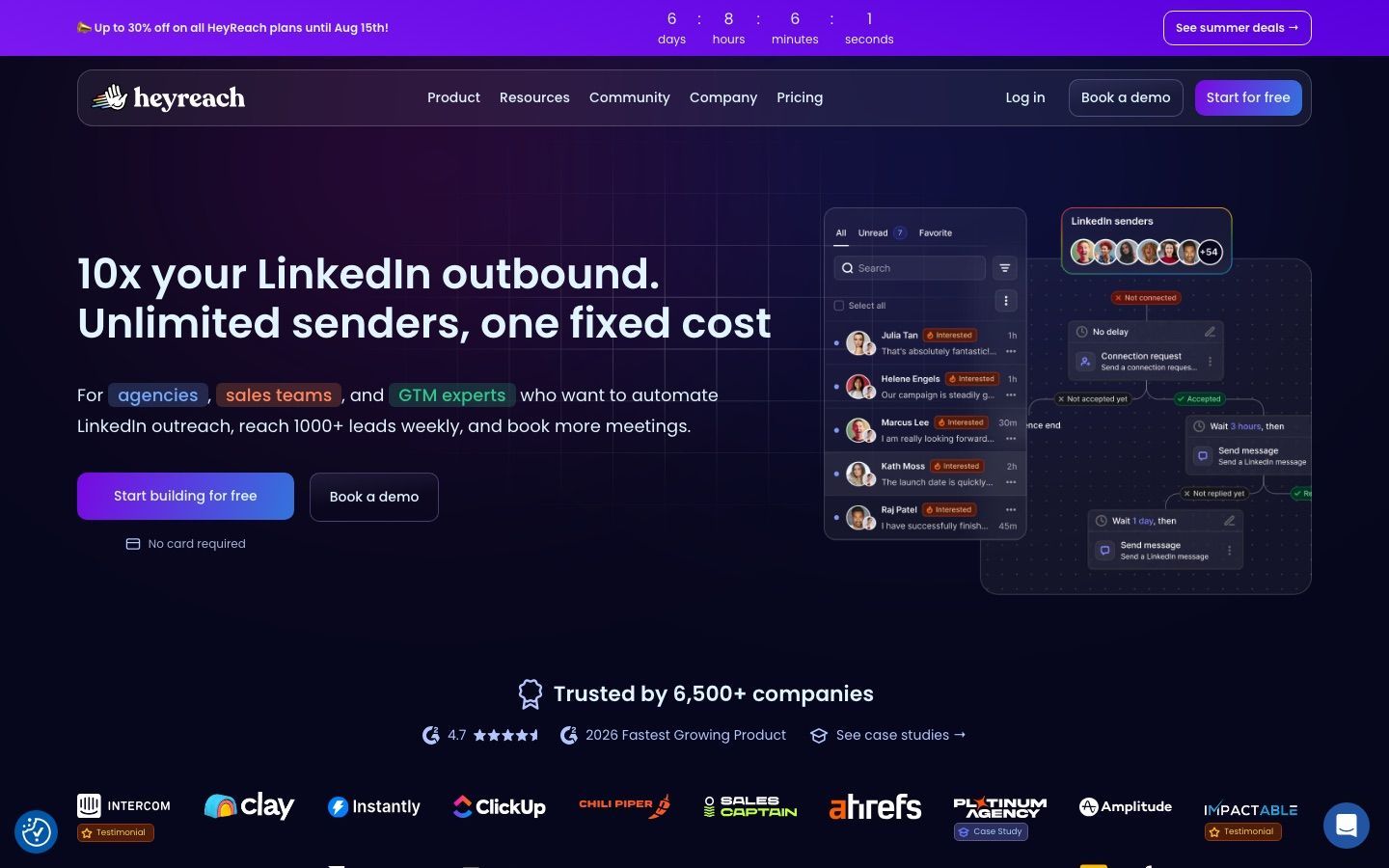
Yes, HeyReach is the other credible fleet option here. Growth is $79 per LinkedIn sender per month ($64 on yearly billing), dropping to $59 per sender from 10 senders ($48 yearly), with a 14 day trial and no card. Above that sit bundles: Agency at $999 for 25 senders or $1,399 for 50 ($800 and $1,120 a month on yearly billing), and Unlimited at $2,999 ($2,399 yearly), capped at 300 senders under a fair-use policy. Users, clients and VAs are free, and a unified inbox, API and webhooks come on every plan.
Two limits matter for a Linked Helper switcher. HeyReach has no native email sending: email steps run through Instantly, Smartlead or EmailBison integrations, and its "email credits" are for finding addresses. It also has no prospect database, so lists arrive by CSV or from another data source. If email needs to sit in the same campaign, price the extra tool alongside the HeyReach plan. Our HeyReach alternatives guide covers where it wins and loses in more depth, and the side by side sets it against Cadency per sender.
Best for: agencies that want a unified inbox and per-sender pricing that flattens into bundles, and that will run LinkedIn and email in separate tools.
Is Expandi worth $99 a month per account instead of $15?
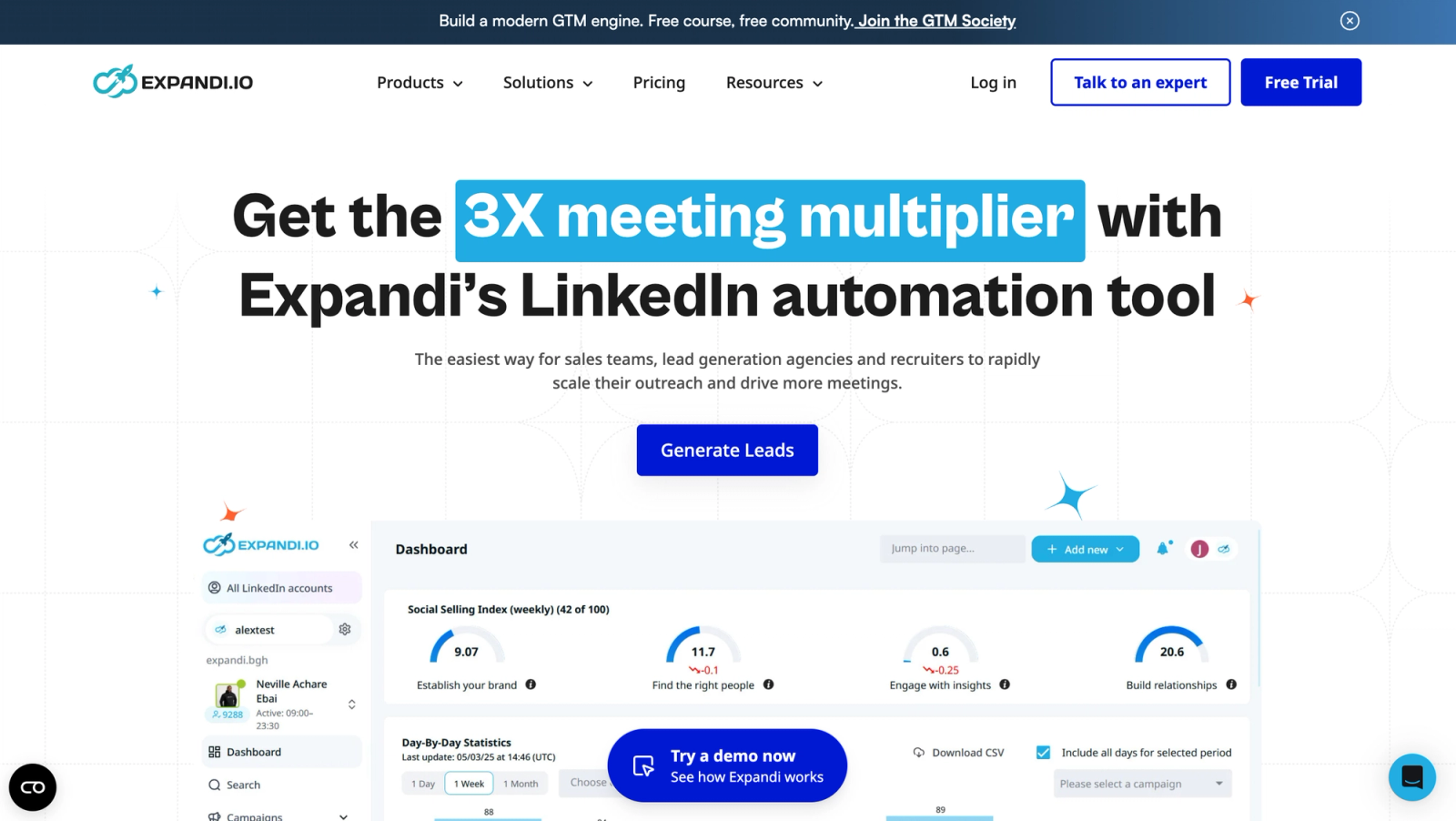
Expandi is the established cloud upgrade for someone leaving Linked Helper, and it has the highest per-account entry price here. The Business plan is $99 per LinkedIn account per month, or $79 on annual billing (20% off, two months free), with a 7 day trial that includes every feature. Agency is custom-priced from 10 seats and adds a volume discount, a dedicated customer success manager, white label, client reports and roles.
It is less bare than the price suggests. Workspaces come on every plan, and teammates and roles do not add seats: only connected LinkedIn accounts do. A global inbox covers every account in a workspace, and shared campaigns run one campaign across several accounts, batching leads every 24 hours against each account's daily limit and deduplicating them. Each account gets a dedicated country-based IP and profile auto warm-up. The action set is wide, including InMail and Open InMail, likes, endorsements, event invites and group messages. Email is native through an SMTP mailbox with threaded follow-ups, though no email warm-up was found and the price still follows LinkedIn seats. HubSpot, Pipedrive and Salesforce connect natively, alongside webhooks and Zapier.
The value case against Linked Helper is the execution model: you pay more than six times as much, about $84 more per seat, for a stable, country-matched IP running around the clock. Whether that is worth it depends on what a restricted account costs you, and at fleet scale the per-account price compounds, as the table above shows. The Expandi alternatives guide compares the field, and the Expandi comparison sets it against Cadency.
Best for: individual operators and small teams who want a mature dedicated-IP cloud setup and will pay per account for it.
Is Dripify the easiest Linked Helper replacement for a solo seller?
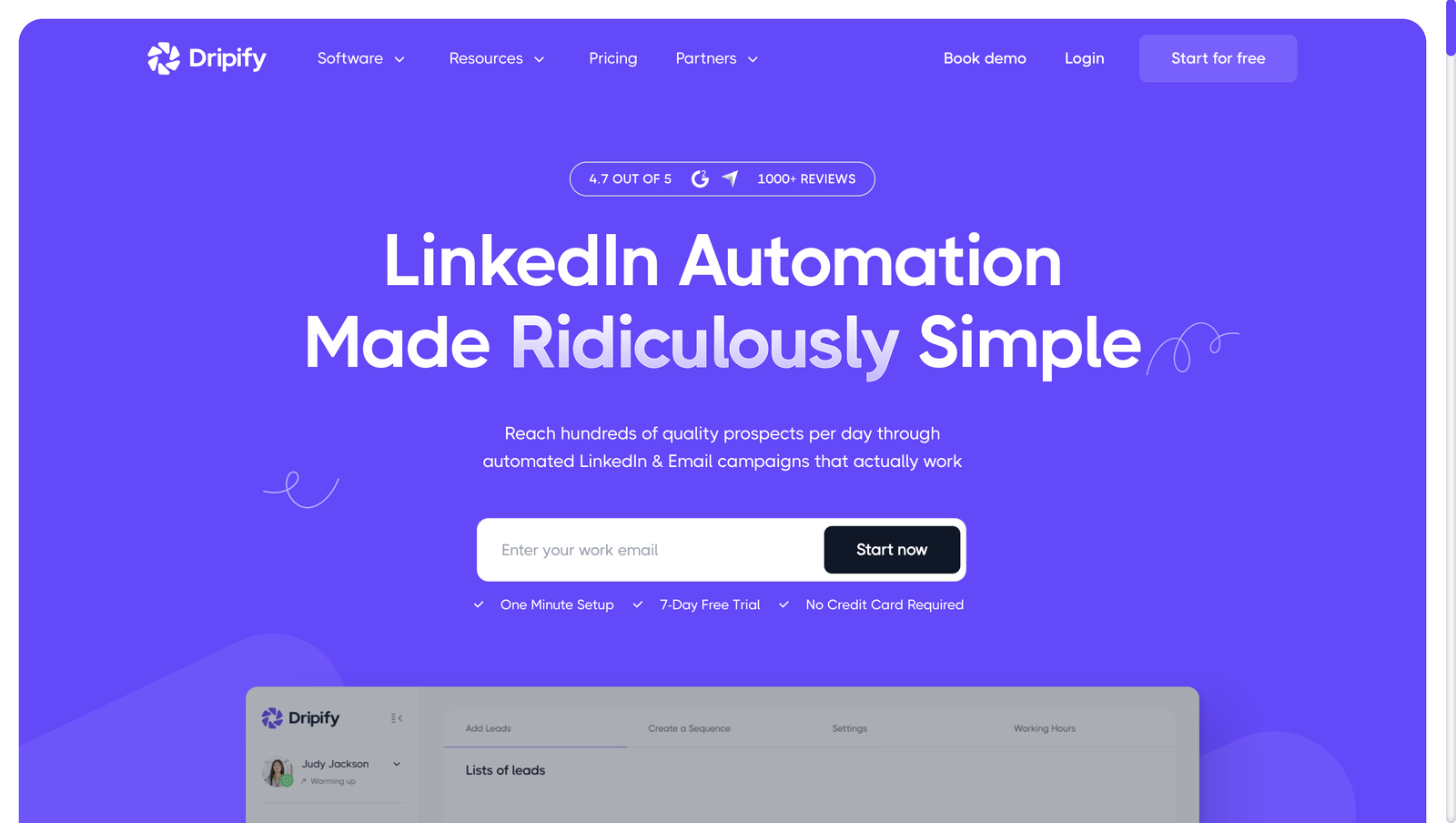
For a solo Linked Helper user who wants a cloud dashboard without learning an agency platform, Dripify is the natural next step. Per user per month it costs $79 for Pro ($59 annually) and $99 for Advanced ($79), with a 7 day trial and no card. The old Basic tier is no longer sold. Every paid plan sends LinkedIn and email in the same sequence, with pre-verified emails, open and reply tracking and 100 email-finder credits a month. If you update old bookmarks, dripify.io now redirects to dripify.com.
Pro is now the entry tier: unlimited campaigns, 75 connection requests, 100 or more messages and 30 InMails a day, webhooks, Zapier, HubSpot, an open API, CSV export and a dedicated inbox. Advanced is where team features begin: multi-team management, step analytics, A/B testing and duplicate-lead prevention across the team. Each seat still drives one LinkedIn account.
Price it at Pro when you compare as one seller, and at Advanced for a managed team. Imports cap at 1,000 profiles per LinkedIn or Recruiter search and 2,475 per Sales Navigator search. The wider landscape is in our Dripify alternatives guide, and the Dripify comparison shows the team-level differences.
Best for: solo sellers and small sales teams who want a simple cloud sequence builder with LinkedIn and email together.
Is Waalaxy the cheapest Linked Helper alternative?
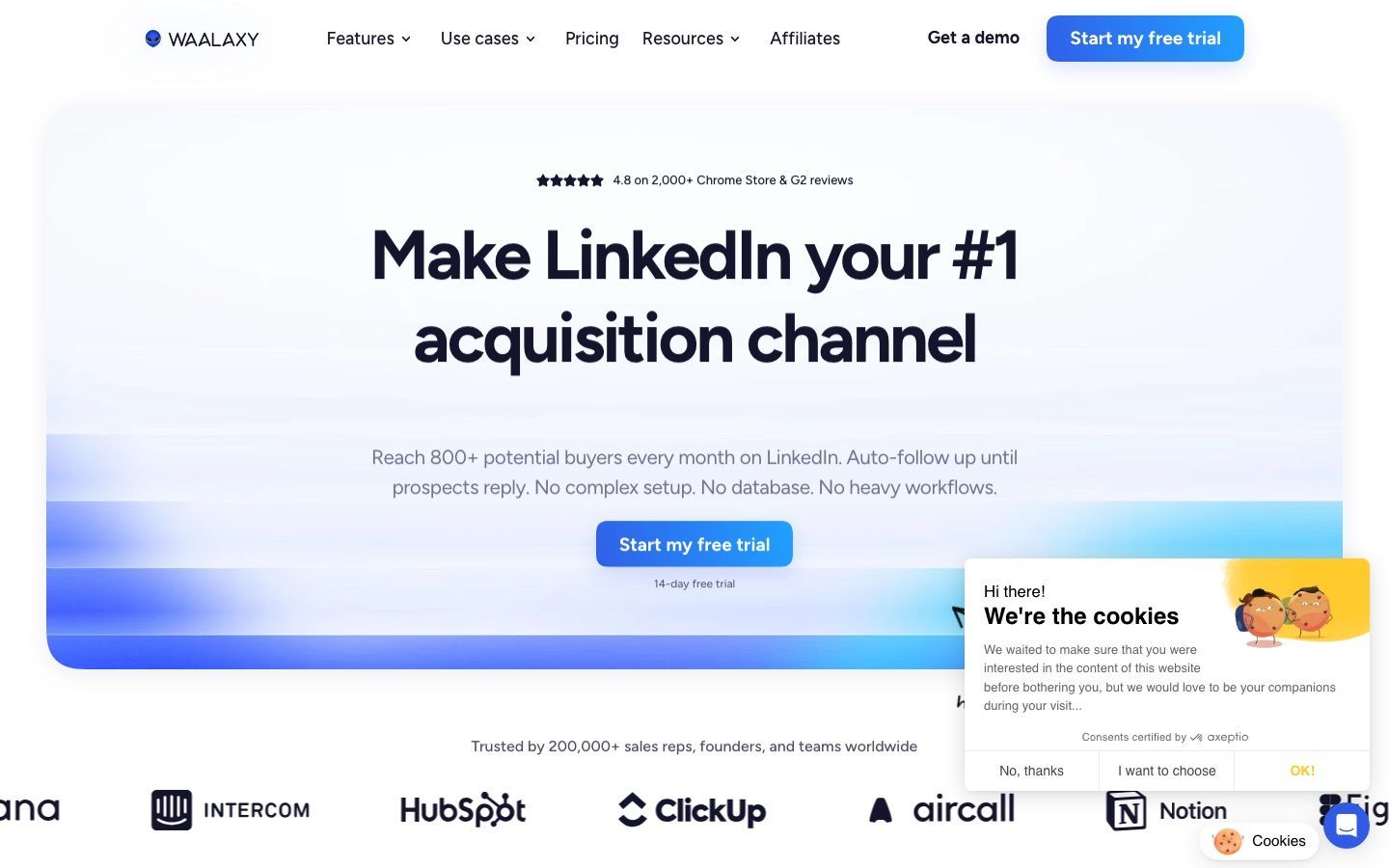
On sticker price, yes. As read on 24 October 2026, Waalaxy Pro is €39 per user a month, or €19 billed yearly, the lowest entry price among the seven. Advanced is €99 and Business €139 a month, or €49 and €69 billed yearly, quarterly billing takes about 20 percent off, and there is a 14 day trial per the pricing page. Prices vary by country: seen from outside the euro zone on 8 October 2026, the page showed a lower US dollar grid, $19, $39 and $69 a month or $16, $32 and $55 billed yearly.
The catch sits in the quotas. Pro allows 300 invitations a month, roughly ten a day; Advanced and Business allow 800, within 200 a week, and each campaign holds up to 5,000 active prospects. Cold email sequences, LinkedIn plus email, arrive only on Business, and the email finder comes with monthly credits (25 on Pro and Advanced, 500 on Business). The API starts at Advanced, along with Make, Zapier and n8n, while CRM sync with 2,000 or more tools is on every plan. The LinkedIn action set is narrow, with no InMail, like or comment, and sequences are pre-built rather than custom.
For several accounts, a Team plan is available on any tier from two licences, discounted from five, with each licence still driving one LinkedIn account. The LinkedIn inbox is a paid add-on with 500 free conversations. Waalaxy now runs fully in the cloud, per a help centre note dated 1 July 2026: there is no Chrome extension, and campaigns run from its web app with the browser closed. Waalaxy says up to five users share each fixed sending IP, though, so if a dedicated IP per account is your reason for leaving Linked Helper, Waalaxy does not offer one. Price it at the tier whose quota you need, not at its entry price. Our Waalaxy competitors guide goes deeper.
Best for: budget-conscious solo users sending low volumes who want the cheapest cloud dashboard on this list.
Does Meet Alfred close Linked Helper's multichannel gap?
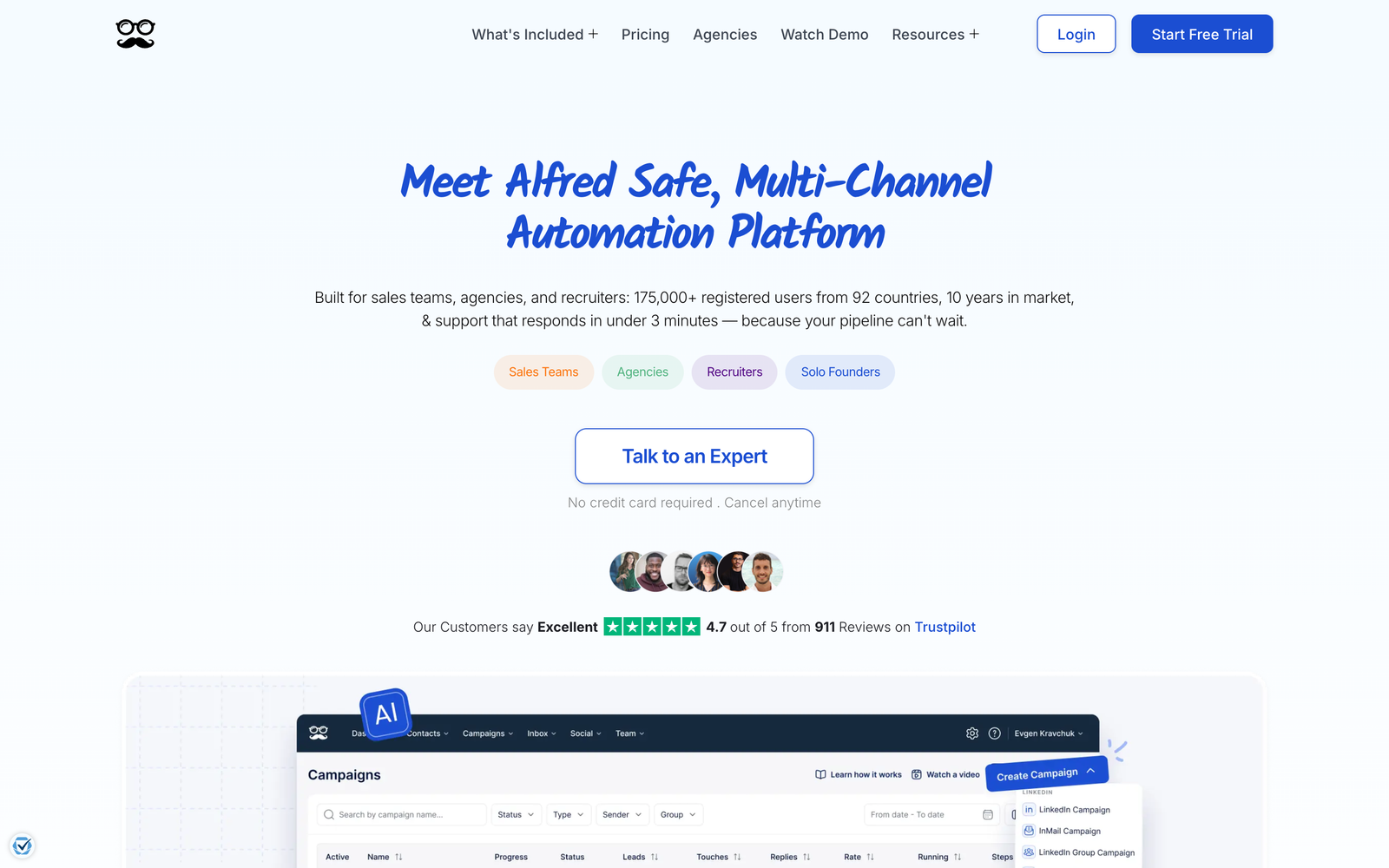
Partly, and with steep annual discounts. As read on 24 October 2026, Meet Alfred prices per user per month: Individual is $59 monthly, $47 quarterly and $35 annual; Teams is $79, $63 and $47 a seat, with a 3-seat minimum; Business is $99, $79 and $59. That is 40 percent off for annual billing, and the free trial needs no card.
The tiers decide what you get. Individual is LinkedIn only and does not include unlimited campaigns, Sales Navigator or lead import and export, though it has a basic CRM, a Smart Inbox and 1,000 Lead Finder results. Email automation, multichannel sequences across LinkedIn, X and email, InMail automation, Sales Navigator support, unlimited campaigns, lead import and export, Zapier and webhooks sit on Business and Teams only, and X campaigns were still marked "under maintenance" in the help centre on 24 October 2026. LinkedIn steps include InMail and messages to group, event and company followers, but no voice notes or comment-on-post step turned up. Audience caps are 1,000 profiles per LinkedIn search URL and 2,500 per Sales Navigator search.
For more than one account, Teams is the plan to price. A second LinkedIn account in one workspace needs Teams (or the custom Unlimited tier), which starts at 3 seats, and Teams manages every account from one dashboard with team inbox management and impersonation, adding white label, roles and permissions and a dedicated account manager. HubSpot and Salesforce connect natively on Teams and Unlimited, with Zapier and webhooks from Business up, but we found no public API. The Meet Alfred comparison lays it next to Cadency.
Best for: small teams that want multichannel sequences on an annual budget and can live with per-user pricing.
Is SalesRobot a safer Linked Helper alternative?
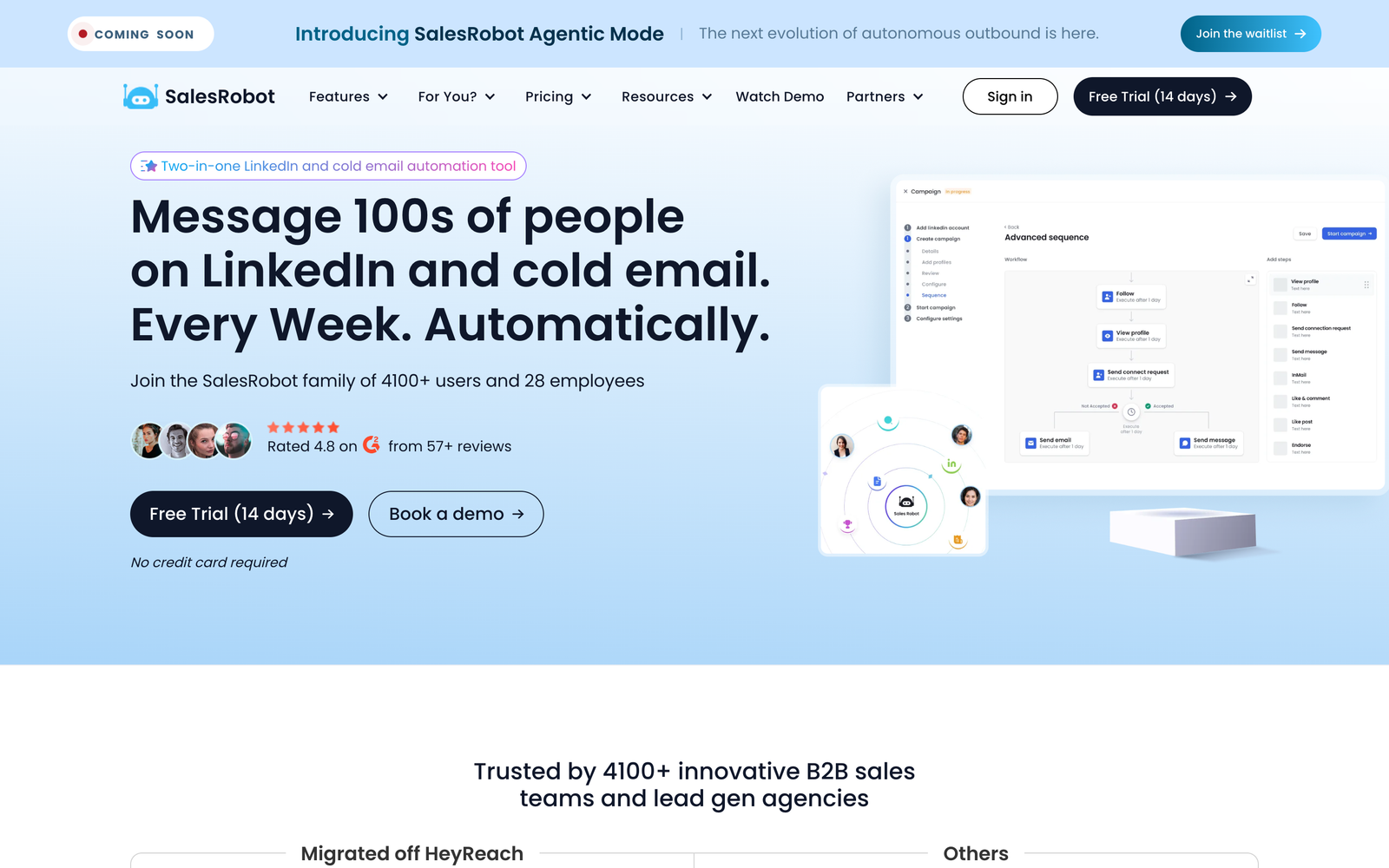
SalesRobot sells LinkedIn plus email plans priced per LinkedIn account per month. Basic is $59 ($39 annually) with one active campaign and limited quotas. Advanced is $79 ($59) with unlimited campaigns, full quotas, webhooks and Zapier. Professional is $99 ($79) and adds team management. Enterprise is custom, and there is a 14 day trial. The ladder lands on the price points Dripify used to charge ($59, $79 and $99 monthly, $39, $59 and $79 annually). Dripify itself now starts at $79 monthly ($59 annually) after dropping Basic.
The structural point for a Linked Helper refugee is the billing unit. Per LinkedIn account is the cost curve you were trying to leave, although SalesRobot's pricing page applies volume discounts: a further 33 percent off from 11 accounts and 45 percent off from 20, with a custom quote beyond 35, as read on salesrobot.co on 24 October 2026. At 5 accounts on Advanced the bill is $395 a month at list, and at 25 it is about $1,100. It is a reasonable Dripify-shaped option with an AI appointment-setting angle, but it stays priced per account, and nothing here suggests it is any safer than the others. Judge safety by where campaigns run and how each account is paced.
Best for: individuals and small teams who want LinkedIn and email in one sequence and will stay under a handful of accounts.
Should you just stay on Linked Helper?
Stay if you are solo, budget-capped and comfortable with a desktop app. Nothing in this guide gets near $15 a month, let alone $8.25 on annual billing, and a switch only pays when you need what Linked Helper structurally cannot do. Stay when all of these hold:
- You run one LinkedIn account and expect to keep it that way.
- Your computer is on during working hours anyway, so machine-bound execution costs you nothing.
- You do not need cloud-run campaigns or one campaign spread across a pool of accounts, only a steady drip of connections and messages.
- The Standard caps (20 advanced actions a day, 620 data credits a month) fit your volume, or the $45 Pro plan does. Details are on the Linked Helper pricing page.
Linked Helper avoids the extension footprint entirely, and its action library is deep for the money. The tools above are not better versions of it but a different kind of product: cloud platforms with a deeper team layer, priced to match. Switch when you become a team, not because a listicle told you to.
Which Linked Helper alternative fits your situation?
- One seller, tightest budget, low volume: Waalaxy, priced at the tier whose quota you need.
- One seller who wants a simple cloud sequence builder: Dripify at Pro.
- LinkedIn plus email for a small team on an annual budget: Meet Alfred at Business or Teams.
- A dedicated country-based IP per account and a mature cloud setup: Expandi.
- A fleet of LinkedIn accounts and a shared inbox, with email handled elsewhere: HeyReach.
- Many LinkedIn senders and unlimited mailboxes running as one campaign, with one inbox: Cadency.
Whichever you shortlist, price the plan you would really run and multiply by your account count, not the entry tier. If you want to see how the two fleet options compare at your headcount, talk to sales and walk through it with the team, or start a free trial on Essential.
Frequently asked questions
Can I run several LinkedIn accounts on one Linked Helper license?
No, one Linked Helper license covers one LinkedIn account. The pricing page lets you switch the connected account, but one license cannot run two accounts at once. A team of five therefore buys five licenses. Linked Helper does offer workspaces, roles and a shared inbox sync, and its cloud-storage edition shares data across accounts automatically, but the automation still runs on your own computers. That per-account, machine-bound model is why growing teams look at sender-based platforms such as Cadency or HeyReach.
Is Linked Helper detectable by LinkedIn?
Any automation tool can be detected, because LinkedIn's User Agreement prohibits bots and automated methods and the platform looks for them. Linked Helper argues that a desktop app is safer than a Chrome extension because it injects no code into LinkedIn pages and imitates human timing and mouse movement. Those are vendor claims, not guarantees. Whichever tool you use, keep volumes conservative and warm accounts up slowly.
Does Linked Helper have an API?
Linked Helper offers outgoing webhooks on both editions and incoming webhooks on the cloud-storage edition, plus native CRM integrations, but we found no full public REST API documented on its pricing page as read on 30 September 2026. Its Standard plan caps webhooks at 20 profiles a day, and Pro removes the daily caps. If outreach has to connect to your own systems, Cadency publishes an API on every plan with webhooks, and HeyReach lists an API and webhooks on all plans.
What is the cheapest Linked Helper alternative?
Waalaxy has the lowest entry price of the seven at €39 per user a month, or €19 billed yearly, but Pro allows only 300 invitations a month, roughly ten a day. On annual billing, the mid tiers that lift the entry caps cost $59 a month for Meet Alfred Business and SalesRobot Advanced, the same as Dripify's entry tier, Pro, now that Basic is gone, and Meet Alfred Teams is $47 a seat with a 3-seat minimum. Nothing matches Linked Helper's own $8.25 a month annual rate, so decide which capability you are buying first.
How do I migrate from Linked Helper to a cloud platform?
Export your contacts and campaign data from Linked Helper, connect your LinkedIn account to the new platform and rebuild your sequences there. Never run both tools on the same account at once, because stacked automation is a quick route to a restriction. Ramp volume back up gradually, as if the account were new to automation, and test with a single account before you move the whole team.
Why is Linked Helper so much cheaper than cloud tools?
Because you supply the infrastructure. Linked Helper runs on your own computer, so the vendor operates no cloud browsers, proxies or always-on sessions for you, and that shows in a $15 monthly price. Cloud platforms charge more per account partly because they run sessions and proxies on their side. The premium only pays off once downtime or a flagged account costs you real pipeline.
Which Linked Helper alternative is best for an agency?
Cadency and HeyReach are the two built around fleets of LinkedIn accounts. HeyReach charges $79 per sender and flattens to $999 for 25 senders on its Agency plan. Cadency's Scale plan is $699 a month with 20 LinkedIn senders included and $25 per extra sender, with unlimited teammates and workspaces. Expandi offers a custom Agency plan from 10 seats. Price each one at your own account count.
Ready to run LinkedIn and email from one engine?
Cadency pools every LinkedIn sender and mailbox into one campaign and one inbox. Essential starts at $89 a month with 2 LinkedIn senders and a free trial.