

The best Reply.io alternatives in 2026 are Cadency, lemlist, Instantly, Smartlead, Apollo, Saleshandy and Snov.io, and the right one depends on which channel does the work in your pipeline. Cadency and lemlist run LinkedIn and email from one sequence. Instantly, Smartlead and Saleshandy cost less for cold email volume. Apollo bundles a contact database with its sequences. Snov.io sells LinkedIn as a separate paid slot, the same way Reply.io does. Every price below was read on the vendor's own pages on 24 October 2026.
Most searches for a Reply.io alternative start with one line on its pricing page: LinkedIn is not part of the entry plan, it is a $69 per account add-on. That line changes the total for any team where LinkedIn carries real weight, so this comparison prices a working team, not just the headline seat.
Disclosure: Cadency is our product. It sits first in the LinkedIn-and-email group because the article is written around teams that send volume on both channels, and it is not the budget pick, since it starts at $89 a month. Where another tool wins, the entry says so.
What does Reply.io cost, and why do teams look elsewhere?
Reply.io's pricing page, read on 24 October 2026 with the annual toggle on by default, breaks down like this.
| Reply.io line | Price as read | What it covers |
|---|---|---|
| Email Volume | $49 per user per month on annual billing, $59 monthly | A meter of 1,000 active contacts each month, with mailboxes unlimited inside fair usage, plus warmup and 50 live data credits monthly |
| LinkedIn add-on | $69 per account per month | LinkedIn automation layered on Email Volume |
| Calls and SMS add-on | $29 | Calling and text messages layered on Email Volume |
| Multichannel | $89 per user per month on annual billing, $99 monthly | Adds LinkedIn, calls, SMS and a WhatsApp semi-automation feature to email, with ten mailboxes per user and unlimited active contacts listed on annual billing (five mailboxes on monthly), extra mailboxes at $29 a month each, CSM onboarding on annual plans and team reports |
| Jason AI SDR | From $500 a month | Reply.io's AI SDR product |
| Custom tier | Quoted | For teams of 20 or more, adding deeper API access and whitelabel options |
Reply.io meters Email Volume in active contacts. A contact counts once you can send it a first-step email in a given month, and follow-ups to that contact cost nothing extra. That meter suits teams that start few conversations and follow up a lot, and it works against the opposite pattern, so compare it with seat-based and mailbox-based pricing before assuming a like-for-like swap.
The pinch comes from LinkedIn. Take five people who each need a LinkedIn account. Email Volume with the add-on on every seat is $118 per person, or $590 a month on annual billing. Multichannel is $89 per person, or $445. The add-on route therefore costs $145 a month more than Multichannel, and Multichannel is also the tier with unlimited active contacts. The add-on only wins when a minority of seats use LinkedIn: with two of the five on it, the total is $383.
The same page quotes 4.6 stars from 1,448 G2 reviews. That is Reply.io's own figure and we have not checked it.
Reply.io remains a sound choice when every seat works several channels, because Multichannel puts email, LinkedIn, calls, SMS and WhatsApp semi-automation into one seat. The alternatives below matter most when LinkedIn is central, when email volume is the constraint, or when headcount keeps growing while the number of channels per person stays flat.
Four questions decide whether leaving is worth the effort:
- How many LinkedIn accounts do you connect, given that each one is billed as its own add-on?
- Does every seat really use LinkedIn, or only a few of them?
- Does your prospect data live in the outreach tool, or in a second subscription? The entry plan carries 50 live data credits a month.
- Would a per-sender or per-mailbox meter fit how you send better than an active-contact meter?
Beyond Reply.io's add-on, the wider market for LinkedIn tools is mapped in our roundup of LinkedIn automation tools.
Which Reply.io alternatives run LinkedIn and email in one campaign?
Two of the seven tools treat LinkedIn as part of the core product instead of an add-on: Cadency and lemlist. They differ in what a unit of price means. lemlist bills people. Cadency bills LinkedIn senders, a LinkedIn sender being one LinkedIn account that is connected and sending.
Cadency: one campaign across every LinkedIn sender and mailbox
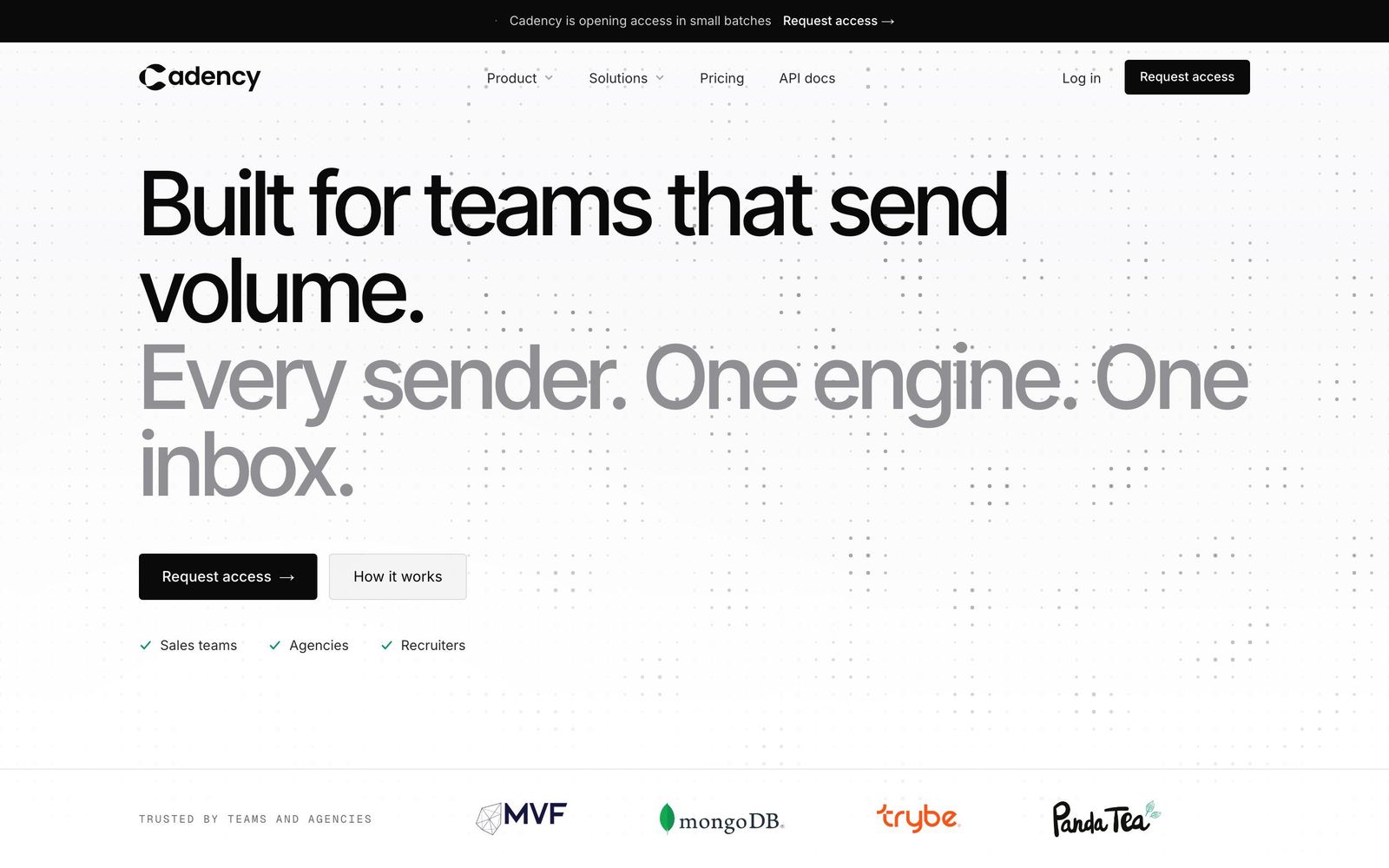
Cadency is outreach software for sales teams, GTM agencies and recruiters that send volume on LinkedIn and email. One campaign runs across every LinkedIn sender and every mailbox, each lead is worked by exactly one sender, and every conversation lands in one inbox. That inbox keeps one thread per lead across LinkedIn and email, threads can be assigned, and a teammate can reply as any sender. Only conversations started from Cadency are tracked, so the rest of a rep's own LinkedIn inbox stays private.
Against Reply.io, the pricing model is the real difference. There is no per-user charge and no LinkedIn add-on: teammates and workspaces are unlimited and free, mailboxes are unlimited, and the bill follows the number of connected LinkedIn accounts. Essential is $89 a month with 2 LinkedIn senders included, $39 for each additional LinkedIn sender and 100,000 emails a month. Small Team is $199 a month with 5 LinkedIn senders included, $39 for each additional LinkedIn sender and 100,000 emails a month. Scale is $699 a month with 20 LinkedIn senders, $25 for each additional sender, 500,000 emails a month (upgrades to 1M cost $200 more and 2M cost $500 more) and priority support. Every plan includes a shared inbox, sequences, reporting, API access and dedicated support. Annual billing takes 30 percent off, which brings the plans to $62, $139 and $489 a month.
What one campaign can do:
- LinkedIn: eight steps, namely profile visit, connection request, message, InMail, a comment on the lead's last post that is AI drafted and waits for your approval, voice note, like and follow.
- Logic: conditions that branch on connected, replied and email found, plus waits and A/B splits.
- Email: Google and Microsoft mailboxes with warm-up, rotated inside the same campaign as the LinkedIn senders.
- Rotation and safety: leads spread across the whole sender pool with per-sender ceilings and pacing, a dedicated proxy for each sender, checkpoint handling, and a cloud setup where nothing runs from your browser. Swarm Profiles, aged LinkedIn profiles and WhatsApp numbers operated for you, can be added through a waitlist. The details sit on the sender rotation and safety pages.
- Data: a native B2B database for people and company search, waterfall enrichment through several providers paid per verified hit, and CSV and Sales Navigator imports. Reply.io's entry plan, by comparison, carries 50 live data credits a month.
- Integrations: API access on every plan and webhooks. Any CRM or ATS connects through the API, so plan a little setup time if you expect a one-click connector.
Where Reply.io still wins:
- Channels: Cadency runs LinkedIn and email only, with no calling, SMS or WhatsApp step.
- Price floor: for email alone, Reply.io's Email Volume seat at $59 monthly ($49 annual) costs less than Cadency's $89 Essential plan ($62 annual).
- Trial: Reply.io lists a 14-day trial, while Cadency's free trial covers Essential only; Small Team and Scale are self-serve but start without a trial.
The product pages for campaigns, the shared inbox and email infrastructure show the model in full, and the pricing page lets you price your own sender count. To try it, start a free trial or talk to sales.
lemlist: per-seat multichannel with LinkedIn built in
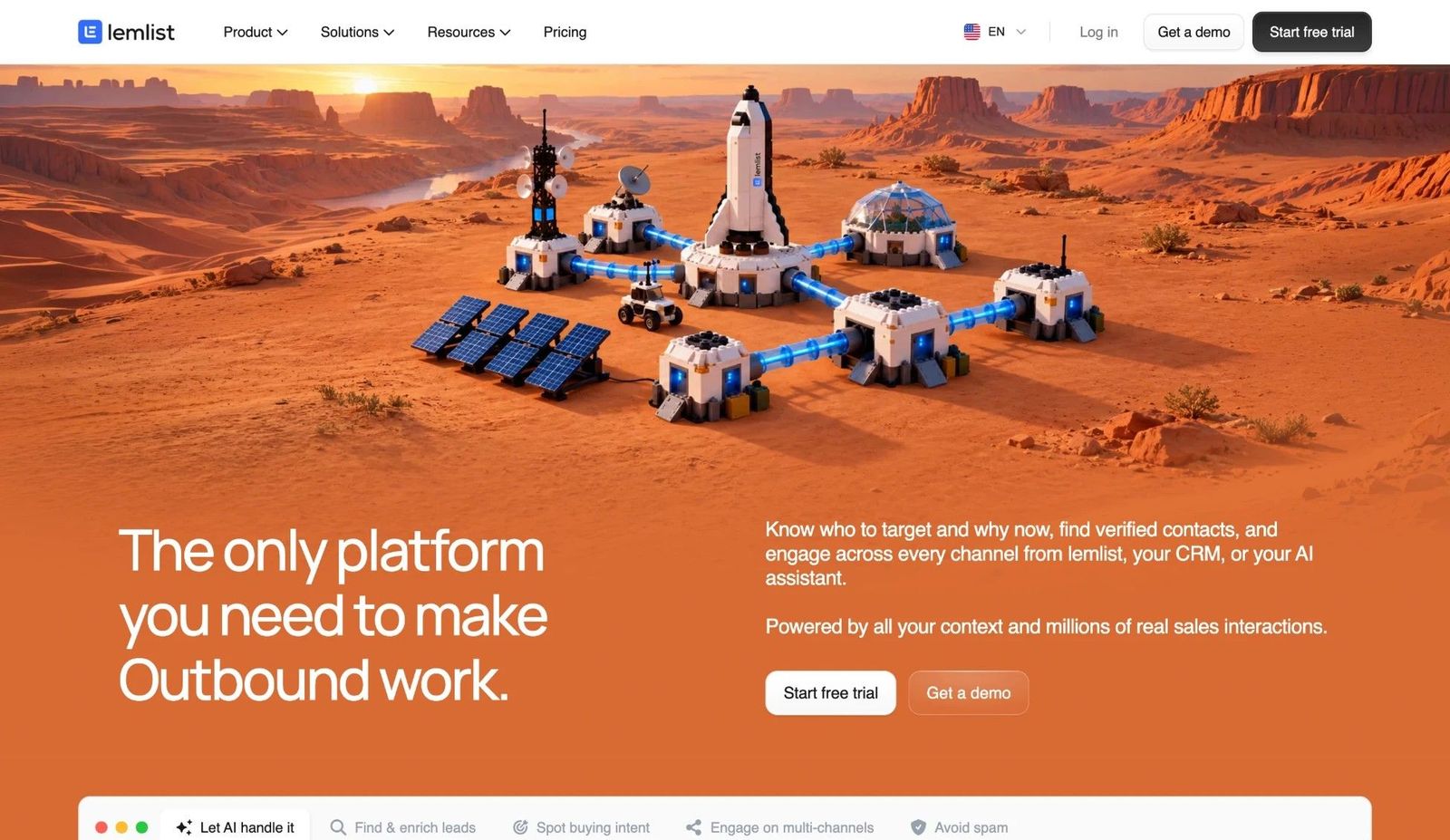
lemlist runs two separate pricing models, as read on 24 October 2026. The Email plan is priced per workspace by monthly volume and carries no LinkedIn. Multichannel is the tier that competes with Reply.io's Multichannel.
| lemlist plan | Price | Notes |
|---|---|---|
| Email, 50,000 emails | $69 a month | Per workspace, no LinkedIn |
| Email, 100,000 emails | $89 | Per workspace |
| Email, 200,000 emails | $159 | Per workspace |
| Email, 500,000 emails | $359 | Per workspace |
| Email, 1M emails | $659 | Per workspace |
| Multichannel | $109 per user monthly ($87 annual) | One LinkedIn account per seat, five sending mailboxes per seat ($9 per extra), no monthly email cap, 400 enrichment credits per user per month |
The Email plan covers unlimited users, warmup inside a deliverability hub, CRM integrations and API access, along with AI agents (lemAgent), an MCP server and a finder for emails and phone numbers that draws on more than 650 million leads. Multichannel then adds the LinkedIn side: profile visits, follows, invites, text messages and voice messages. It also brings the unified inbox, SMS automation, a WhatsApp add-on, manual steps and a call dialer with VoIP integrations.
Enrichment spends credits at one cent each: 5 for a verified email and 20 for a phone number. The smallest Enrichment add-on, 2,000 credits for $20 a month, therefore covers about 400 emails or 100 numbers. lemlist quotes a 4.6 rating over 2,240+ G2 reviews and says more than 20,000 sales teams use it, both its own claims. A 14-day free trial, with no card, opens the Multichannel features; lemlist's help center says the Email plan has no trial of its own.
Strong points:
- A single per-seat price spans email and LinkedIn, and calls and SMS live in the same tool.
- AI agents and an MCP server are part of the package for programmatic use.
- On annual billing, $87 per seat edges under Reply.io's $89 Multichannel.
Trade-offs:
- On monthly billing, $109 per seat is above Reply.io's $99 Multichannel.
- One LinkedIn account per seat means each extra LinkedIn account is an extra seat.
- WhatsApp costs extra instead of sitting inside the Multichannel price.
lemlist is the nearest replacement for Reply.io's Multichannel plan, since both roll LinkedIn into a per-user price. For email alone, its 50,000-email tier at $69 sits above Instantly's Growth at $47 and Smartlead's Base at $39, though those two include far fewer sends. The lemlist review covers the full feature set, and the Cadency versus lemlist comparison sets the two side by side.
Which Reply.io alternatives are cheaper for cold email volume?
Three tools go after Email Volume on sending capacity: Instantly, Smartlead and Saleshandy. None of them runs LinkedIn steps natively. Instantly has no LinkedIn at all, Smartlead hands LinkedIn to HeyReach or Aimfox, and Saleshandy offers manual tasks or the same relay, so automated LinkedIn means a second bill and a second inbox. The cold email software roundup covers the category more widely.
Instantly: high-volume cold email with no LinkedIn
Instantly's outreach plans, as read on 24 October 2026, step up in three tiers, with 20 percent off on annual billing.
| Instantly tier | Price a month | Emails a month | Uploaded contacts |
|---|---|---|---|
| Growth | $47 | 5,000 | 1,000 |
| Hypergrowth | $107 | 125,000 | 25,000 |
| Light Speed | $358 | 500,000 | 100,000 |
Every tier allows unlimited email accounts and unlimited warmup. Growth support is by chat, Hypergrowth adds premium live support, and Light Speed adds SISR, a private sending infrastructure aimed at high-volume senders.
Data is bought separately: leads, CRM and inbox placement are each their own subscription. Growth Credits are $47 a month for 1,500 credits and Hyper Credits are $197 for 10,000, drawn from a database of more than 450 million B2B leads. Instantly says Outreach and Credits can also be bought as bundles, but its pricing page no longer shows them (the Bundles tab is hidden); the page source still lists Starter $94, Scale $194 and Agency $555 a month, or $85, $175 and $500 a month on yearly billing with a "Save 10%" badge. Instantly lists no LinkedIn automation.
Strong points:
- Mailbox and warmup limits stay open from the $47 tier upward.
- Light Speed is designed for senders at 500,000 emails a month.
- Lead credits are optional, so light users do not pay for data they never touch.
Trade-offs:
- There is no LinkedIn channel, so LinkedIn stays in another tool.
- Lead credits mean a second bill next to the outreach plan.
Instantly fits a team that has already dropped LinkedIn from Reply.io and wants cheaper email at higher volume. The Instantly alternatives guide goes deeper, and the Cadency versus Instantly comparison covers the two-channel case.
Smartlead: the lowest entry price for real volume
Smartlead's four tiers, read on 24 October 2026, cost $39, $94, $174 and $379 a month on monthly billing. Yearly billing shows $32, $78, $144 and $315 a month, roughly 17 percent lower.
| Smartlead tier | Monthly price | Emails a month | Contacts | Verified emails |
|---|---|---|---|---|
| Base | $39 | 6,000 | 2,000 | 2,000 with the $59 a month add-on |
| Pro | $94 | 90,000 | 30,000 | 30,000 with the $59 a month add-on |
| Unlimited Smart | $174 | 150,000 | No cap | 50,000 |
| Unlimited Prime | $379 | 500,000, across three SmartServers | No cap | 170,000 |
The word "unlimited" in the tier names refers to leads, not to sends. Client workspaces are $29 each and servers are $39 each, and SmartSenders, its mailbox add-on, is priced between $3.99 and $9 per mailbox a month. API, webhook and CRM access, along with client workspaces, differ by tier, so confirm which plan unlocks each before you buy. LinkedIn reaches Smartlead only through integrations such as HeyReach or Aimfox.
Smartlead earns a look when the goal is real sending volume at the smallest starting bill, since Base at $39 undercuts most entry tiers in this article. It is the wrong fit if you want LinkedIn built in or a contact database inside the product, because what it sells is sending capacity. The Cadency versus Smartlead comparison shows what changes when LinkedIn joins the same campaign.
Saleshandy: budget email with a lead finder attached
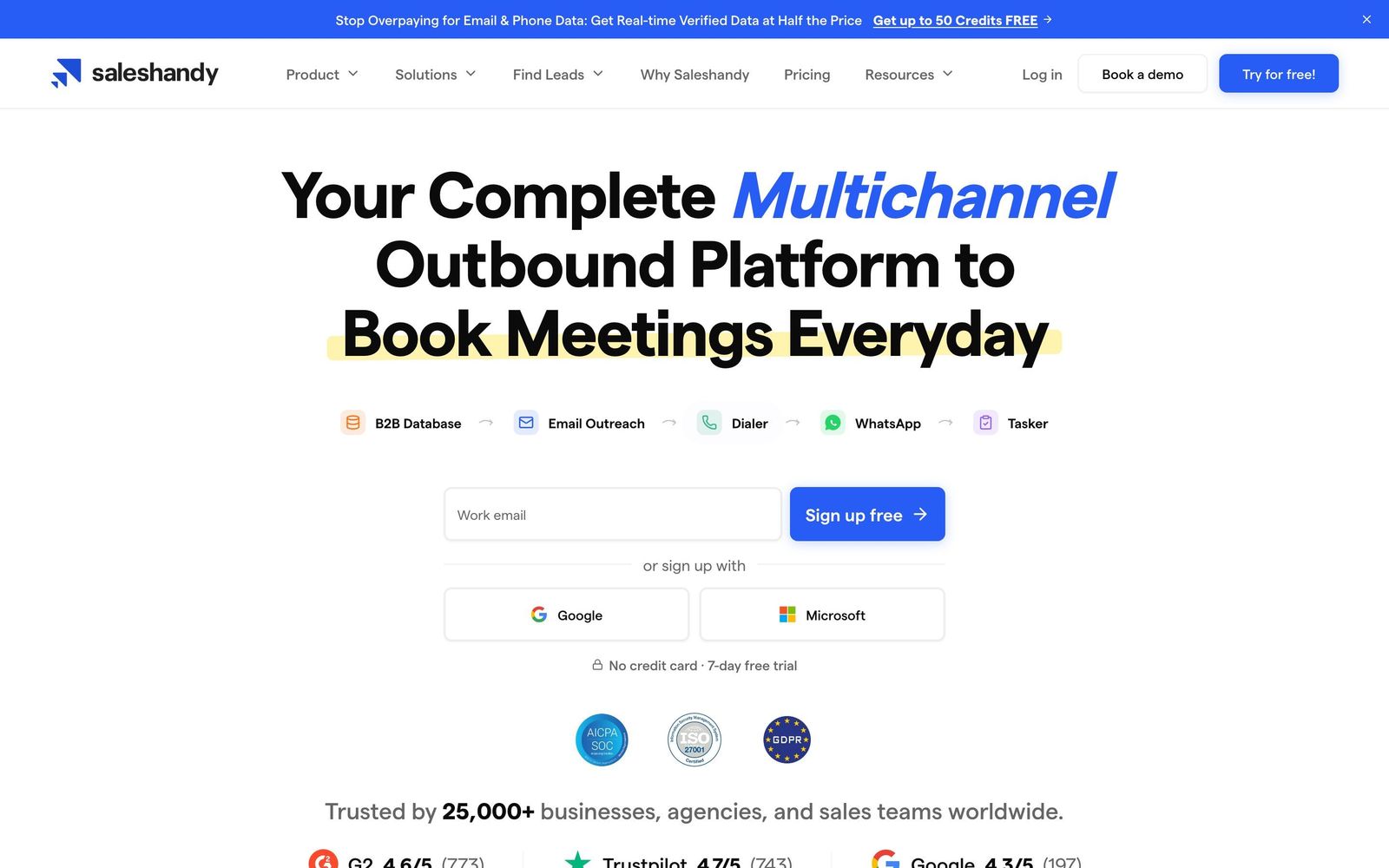
Saleshandy's three plans, read on 24 October 2026, cost $41, $99 and $189 a month on monthly billing, and $34 (that is $408 a year), $76 and $149 a month when billed annually.
| Saleshandy plan | Monthly price | Emails a month | Also includes |
|---|---|---|---|
| Starter | $41 | 6,000 | The entry tier |
| Pro | $99 | 100,000 | 10 users, 30,000 active prospects, unlimited email accounts, 4,000 lead finder credits a month, API access, an MCP server and a CLI |
| Scale | $189 | 200,000 | Unlimited prospects |
Every plan, Starter included, opens a B2B database of more than 852 million contacts across 42 million-plus companies. Scale's volume selector continues to 300,000 emails at $299 and 600,000 at $599 a month ($239 and $479 billed annually). The Enterprise tier is quoted individually and adds SSO and whitelabel. Ready-made mailboxes are priced from $2.99 a month on an annual fixed plan with a 1-mailbox minimum, $3.49 on Annual Flexi with a 25-mailbox minimum, or $3.99 quarterly. LinkedIn on Saleshandy means manual tasks or a relay into HeyReach or Aimfox, not native automation, and the trial runs 7 days with no credit card.
Saleshandy suits a budget-first team that wants lead finder credits inside the plan rather than as a paid add-on, the way Reply.io sells LinkedIn. It stops fitting when you need native LinkedIn steps or send past 600,000 emails a month, where Scale's self-serve selector ends. The Cadency versus Saleshandy comparison covers the LinkedIn gap.
Which other Reply.io competitors bundle data or sell LinkedIn as a slot?
Two remaining tools sit outside the groups above. Apollo folds a contact database into its sequences, and Snov.io follows the same model as Reply.io, a base email plan with LinkedIn charged on top.
Apollo: a contact database, a dialer and sequences per seat
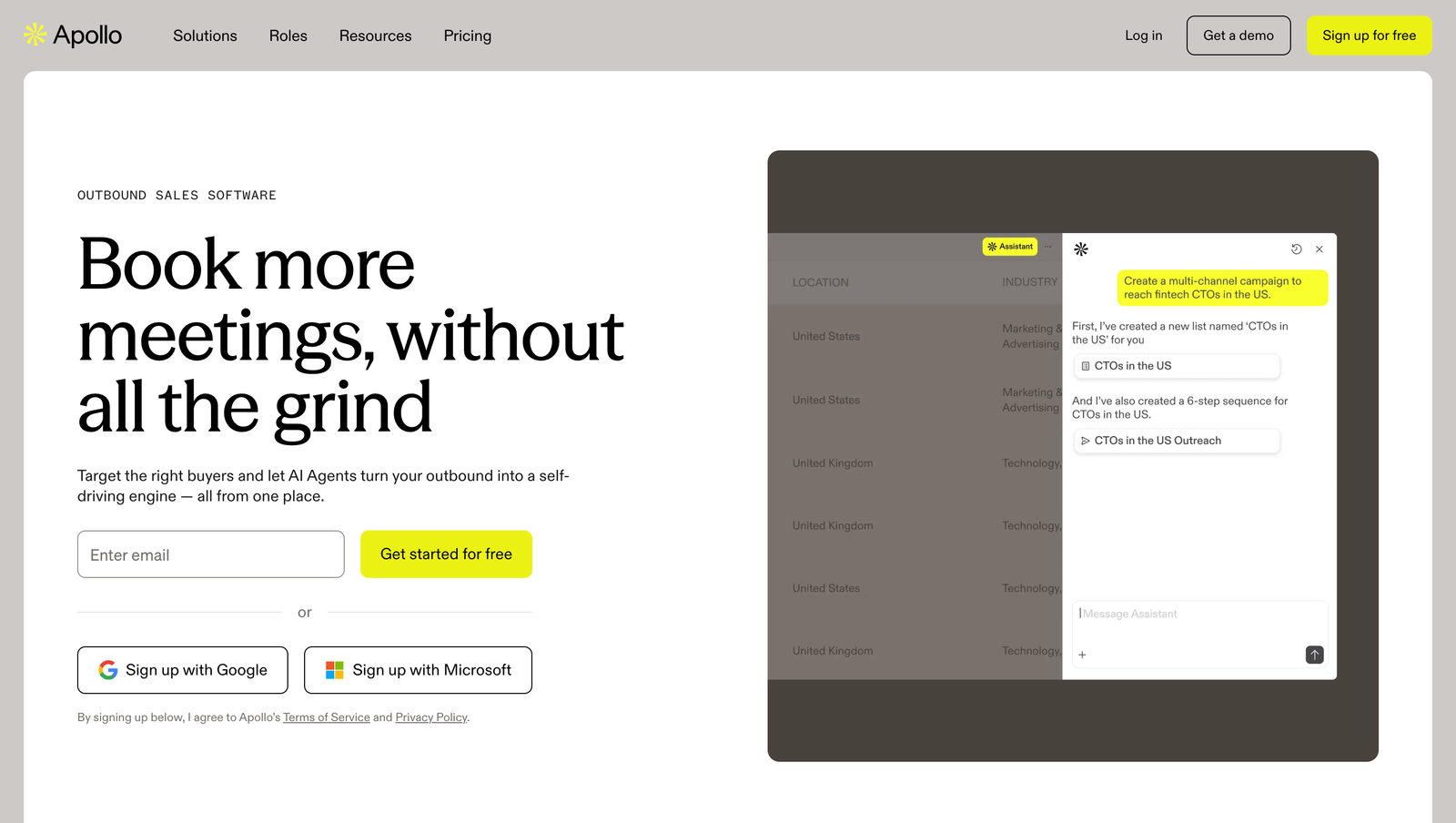
Apollo's tiers, read on 24 October 2026 with both billing toggles checked, differ mainly in credits and workflow features.
| Apollo tier | Per seat a month, annual billing | Monthly billing | Credits per seat per year |
|---|---|---|---|
| Free | $0 | $0 | 900, granted monthly |
| Basic | $49 | $65 | 30,000 |
| Professional | $79 | $99 | 48,000 |
| Organization | $119, three-seat minimum | $149 shown, marked annual only | 72,000 |
What each tier adds:
- Free: API access, 2 sequences and an AI assistant limited to 5 conversations.
- Basic: unlimited sequences, waterfall enrichment, CRM integrations, 6 intent topics and 100 identified website visitors a month, plus a deliverability suite with warmup. The 30,000 credits arrive upfront on annual billing or as 2,500 a month on monthly billing.
- Professional: 50 automated workflows per team (Basic has 5), agents and A/Z testing, unlimited Gmail and Microsoft mailboxes, and 4,000 minutes of recorded calls with AI insights per user a month.
- Organization: 72,000 credits per seat per year and a three-seat minimum. Its monthly view shows $149 and 6,000 credits a month, marked annual only, so treat it as an annual contract.
Credits are the catch. A phone number costs 8 credits and enrichment costs 1 to 8 per record, so Basic's 30,000 yearly credits stretch to roughly 3,750 phone numbers. Across twelve months a Basic seat costs $588 on annual billing and $780 paid monthly, Professional costs $948 against $1,188, and Organization starts at $4,284 a year because of the three-seat minimum. Apollo says its database holds 240 million contacts across 30 million companies, and it also lists an MCP server and a parallel dialer. No LinkedIn automation appears on its pricing.
Apollo fits teams that want one seat price to cover a database, a dialer and sequences, instead of pairing Reply.io's live data credits with a second tool. It fits badly if you need LinkedIn steps, or if metered credits make the budget harder to predict than a flat seat price would. Apollo is a data platform first, so teams that only want search, enrichment and sending together can look at Cadency's database and waterfall enrichment instead. More options are in the Apollo alternatives roundup.
Snov.io: LinkedIn sold as a separate slot, like Reply.io
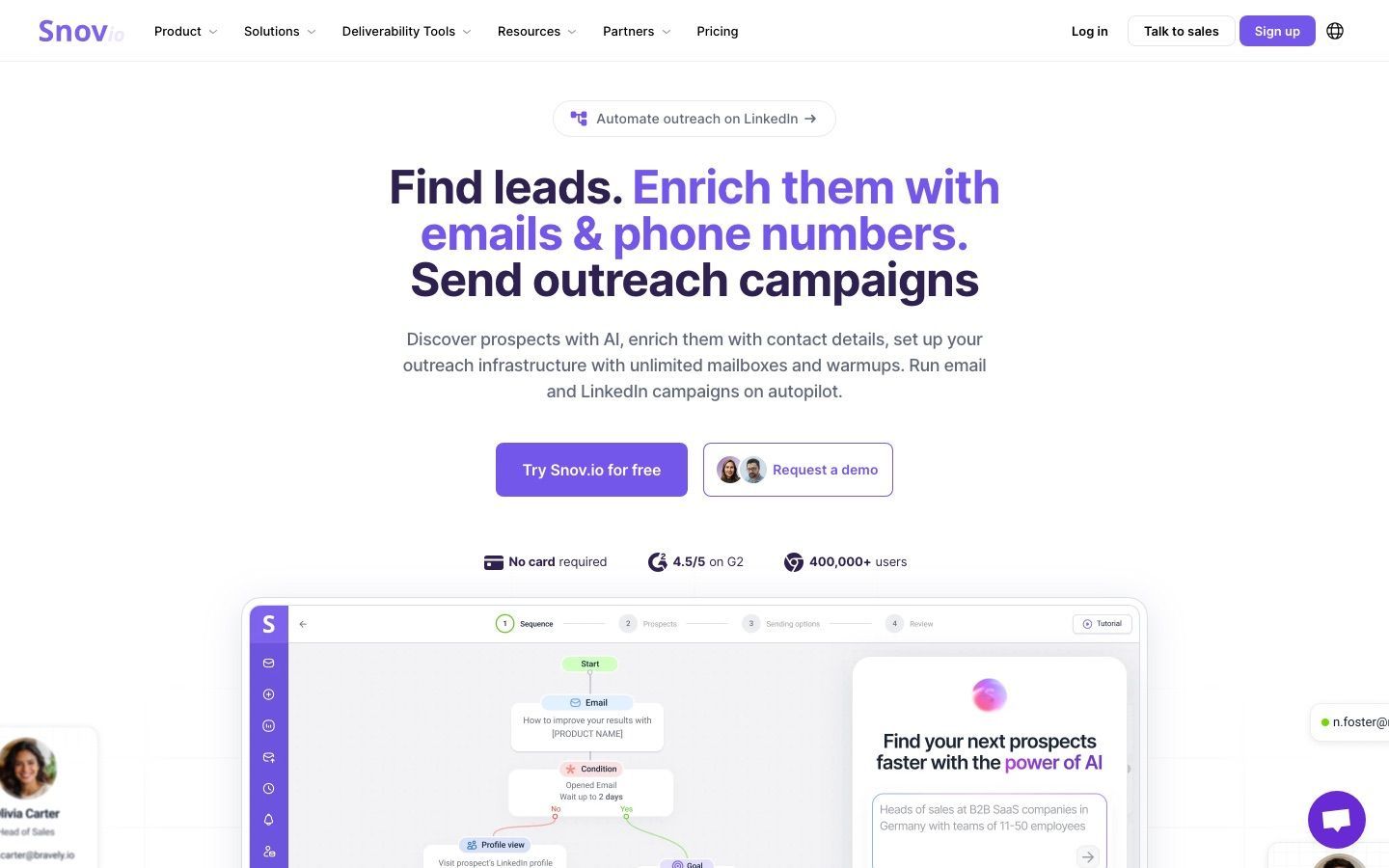
Snov.io advertises 25 percent off on annual subscriptions. As read on 24 October 2026, its plans look like this.
| Snov.io line | Price a month |
|---|---|
| Starter | $39 |
| Pro S | $99 |
| Pro M | $189 |
| Pro L | $369 |
| Ultra | $738 |
| LinkedIn slot, per LinkedIn account | $69 monthly, $62 on a yearly plan, and $10 a month less per slot with a paid plan |
LinkedIn automation is not part of the email plans. It is bought as a slot per LinkedIn account and covers messages, InMail, connection requests, follows and skill endorsements. As read on snov.io on 24 October 2026, its pricing FAQ takes a further $10 a month off each slot when you also hold a paid plan, and its help center gives that bundled price as $59.
Strong points:
- LinkedIn actions include InMail and skill endorsements, not only connection requests and messages.
- Starter at $39 a month sits below Reply.io's Email Volume at $49 annual or $59 monthly.
- The MCP server is listed next to the outreach plans.
Trade-offs:
- LinkedIn is a separate per-account slot at $69 a month, or $59 with a paid plan, against Reply.io's $69 add-on.
- The 25 percent discount is for annual billing only, so the monthly prices above are the higher ones.
Snov.io copies Reply.io's structure more closely than anything else here: email plans as the core product, and LinkedIn charged separately per slot, at $69 a month standalone or $59 alongside a paid plan, against Reply.io's $69. The difference is the base tier, and because the two pages do not size their plans the same way, line up the sending limits before you trust the saving. It is the wrong choice if what you want is to be rid of a LinkedIn surcharge entirely.
How do the seven Reply.io alternatives compare on price and channels?
Reply.io leads the table as the baseline. Prices are entry points as read on 24 October 2026.
| Tool | Entry price | ||
|---|---|---|---|
| Reply.io | $69 per account add-on, or inside Multichannel | 1,000 active contacts a month on Email Volume | Email Volume $49 per user annual ($59 monthly), Multichannel $89 annual ($99 monthly) |
| Cadency | Eight native steps, included | Google and Microsoft mailboxes, unlimited, 100,000 emails a month on Essential and Small Team | Essential $89 a month with 2 LinkedIn senders ($62 annual) |
| lemlist | Multichannel only, one account per seat | Email plan by volume, 5 mailboxes per seat on Multichannel | Email $69 for 50,000 emails, Multichannel $109 per user ($87 annual) |
| Instantly | None | 5,000 emails a month on Growth | Growth $47, Hypergrowth $107, Light Speed $358 |
| Smartlead | Not native, through integrations such as HeyReach or Aimfox | 6,000 emails a month on Base | Base $39 ($32 yearly) |
| Apollo | None listed | Sequences and warmup from Basic | Basic $49 per seat annual ($65 monthly) |
| Saleshandy | Manual tasks or a HeyReach or Aimfox relay | 6,000 emails a month on Starter | Starter $41 monthly ($34 annual) |
| Snov.io | Separate slot, $69 monthly ($62 yearly), $59 monthly with a paid plan | Email plans from Starter | Starter $39 |
Two patterns show up. Only Reply.io and Snov.io charge for LinkedIn as a separate slot, yet Reply.io's own Multichannel bundle beats stacking its add-on onto the entry plan. Meanwhile the three email specialists, Instantly, Smartlead and Saleshandy, have no native LinkedIn, so moving to them repairs the email side of the bill and nothing else.
What does a five-person team pay for LinkedIn plus email?
Headline seat prices hide the units, so here is one team shape priced four ways: five people, each running one LinkedIn account and sending email. The figures multiply the published per-seat prices or use the published plan price.
| Setup | Per month, annual billing | Per month, monthly billing |
|---|---|---|
| Reply.io Email Volume plus the LinkedIn add-on, 5 seats | $590 | $640 |
| Reply.io Multichannel, 5 seats | $445 | $495 |
| lemlist Multichannel, 5 seats | $435 | $545 |
| Cadency Small Team, 5 LinkedIn senders | $139 | $199 |
Reply.io quotes the add-on at $69 without a separate monthly figure, so the monthly cell in its first row assumes the same price.
Cadency's total is lower on this particular shape because its unit is the LinkedIn sender and the plan carries unlimited teammates and mailboxes. That is a property of the team shape, not a claim that Cadency is the cheapest tool: it is not, and the email-only tools above start far lower. The advantage also shrinks with team size. For a single person, Reply.io's entry plan costs less than Cadency's $89 Essential plan but includes no LinkedIn, and one lemlist seat costs more. On Small Team, each LinkedIn sender beyond five is $39. The table leaves out what Reply.io and lemlist bundle that Cadency does not: calls, SMS and WhatsApp.
What should you check before leaving Reply.io?
Switching tools is mostly logistics, and a few checks prevent the expensive mistakes.
- Export contact lists, sequence copy and the suppression list first, so anyone who opted out is never contacted again from the new tool.
- Disconnect each LinkedIn account from Reply.io before you connect it anywhere else, so two tools never act on the same account at once.
- Restart at lower volume for the first days rather than at full pace. LinkedIn's own invitation limits apply on top of every tool's settings, and the connection limits guide explains the caps underneath.
- Map how replies are detected and who owns each thread, since that logic is easy to lose in a move.
- Decide how contacts reach your CRM. Most tools here connect through an API or webhooks, and the safety guide explains what ceilings, pacing and dedicated proxies protect against.
Which Reply.io alternative should you choose?
Start from the channel that actually books your meetings, then check which tool prices that channel without a surcharge.
| Your situation | Best fit |
|---|---|
| A team working LinkedIn and email together, wanting one campaign and one inbox | Cadency |
| Reps who want LinkedIn, email, SMS and calls at a per-seat price | lemlist Multichannel, or staying on Reply.io Multichannel |
| High email volume and no LinkedIn motion | Instantly or Smartlead |
| A bundled contact database and dialer alongside email sequences | Apollo |
| Low per-seat email cost with lead finder credits inside the plan | Saleshandy |
| LinkedIn as a paid slot like Reply.io's, on a lower base email price | Snov.io |
A split stack is also legitimate: Instantly or Smartlead for email, plus a dedicated LinkedIn tool. HeyReach, read on 24 October 2026, charges $79 per LinkedIn sender a month, or $64 on yearly billing, and its email steps run through Instantly, Smartlead or EmailBison integrations. That works, and it also means two inboxes and two bills, which is the cost to weigh against one campaign across both channels. The HeyReach review has the details.
The short version
Reply.io sells email as the core product and treats LinkedIn as an extra, and most of the alternatives differ in how they fix that. Cadency and lemlist build LinkedIn in, Snov.io keeps the slot model, and the email specialists Instantly, Smartlead and Saleshandy all undercut Email Volume on sending capacity, while Apollo lands near its price with a far larger database attached.
Pick the tool for the channel that does the work, then price the team you actually have. A five-person team with five LinkedIn accounts and one shared inbox is a very different bill from one rep on a single seat.
Frequently asked questions
What is the best Reply.io alternative in 2026?
For LinkedIn plus email, pick Cadency or lemlist; for cold email volume, Instantly, Smartlead or Saleshandy; for a bundled contact database, Apollo. Cadency and lemlist run both channels in one sequence. Cadency starts at $89 a month for 2 LinkedIn senders ($62 on annual billing), with unlimited teammates, while lemlist Multichannel charges per seat from $87 a month on annual billing.
Is Reply.io worth it in 2026?
Yes, when every seat needs email, LinkedIn, calls and SMS in one tool and the team accepts paying for Multichannel, from $89 per user per month on annual billing. It is harder to justify when only a few people touch LinkedIn or one channel does most of the work, because the $69 per account LinkedIn add-on and the per-user bundle both grow with headcount.
How much does Reply.io cost in 2026?
Reply.io costs from $49 per user per month on annual billing ($59 monthly) for the Email Volume plan, which covers 1,000 active contacts a month, as read on 24 October 2026. Multichannel starts at $89 per user annually or $99 monthly and adds LinkedIn, calls, SMS and a WhatsApp semi-automation feature. LinkedIn on Email Volume is a separate $69 per account per month, and calls and SMS add another $29.
Does Reply.io include LinkedIn automation?
Not on its entry plan. Email Volume leaves LinkedIn out, so you either pay $69 per account per month on top or move up to Multichannel, from $89 per user per month on annual billing. For five people the add-on route totals $590 a month on annual billing against $445 for Multichannel, which is why buying Multichannel outright is usually the cheaper way to get LinkedIn.
What is the cheapest Reply.io alternative for cold email only?
As read on 24 October 2026, Smartlead's Base plan is the lowest entry price among the email-only options here, at $39 a month for 6,000 emails, or $32 on yearly billing. Saleshandy's Starter follows at $41 monthly ($34 annual) for 6,000 emails, and Instantly's Growth costs $47 for 5,000. Weigh the sending limits as well as the price, and remember that none of the three runs LinkedIn steps natively.
Which Reply.io alternative includes a contact database?
Apollo and Saleshandy put the largest databases inside the outreach plan. Apollo advertises 240 million contacts across 30 million companies, with 900 credits a year on its free plan and 30,000 per seat a year from Basic, and Saleshandy lists 852 million-plus contacts alongside 4,000 lead finder credits a month on Pro. Cadency has a native people and company database with waterfall enrichment paid per verified hit, for teams that want search and sending together. Reply.io's entry plan carries 50 live data credits a month.
Which Reply.io alternatives offer a trial?
Reply.io and lemlist each list a 14-day trial, Saleshandy lists 7 days with no credit card, and Apollo has a free plan with 900 credits per seat per year plus a 14-day trial on Basic and Professional. Instantly and Smartlead both run 14-day free trials with no card: Instantly states it in its help center and in the pricing.md file its pricing page links to (1,000 emails, 250 contacts), and Smartlead in its help center (2,500 sends, 1,250 contacts), while its pricing page only says every plan has a free trial. Cadency's free trial covers Essential only; Small Team and Scale are self-serve but start without a trial.
Ready to run LinkedIn and email from one engine?
Cadency pools every LinkedIn sender and mailbox into one campaign and one inbox. Essential starts at $89 a month with 2 LinkedIn senders and a free trial.