
HeyReach is a cloud based LinkedIn automation tool that bills per connected LinkedIn account, rotates one campaign across a pool of those accounts and collects every reply in one inbox. As read on heyreach.io/pricing on 24 October 2026, Growth costs $79 per sender a month ($64 on yearly billing), drops to $59 per sender from ten senders ($48 yearly), the Agency plan is $999 a month for 25 senders ($800 billed yearly) or $1,399 for 50 ($1,120 billed yearly), and Unlimited is $2,999 ($2,399 billed yearly), capped at 300 senders under a fair-use policy. API, webhooks and an MCP server ship on every plan. Email does not: it is handed off to Instantly, Smartlead or EmailBison.
This HeyReach review works through what that money buys, where the limits sit, and which kind of team ends up happy with it. Every HeyReach figure below comes from the vendor's own pricing page or help center, with the check date next to it, and the comparison at the end is honest about where HeyReach is the cheaper choice.
What is HeyReach and who is it built for?
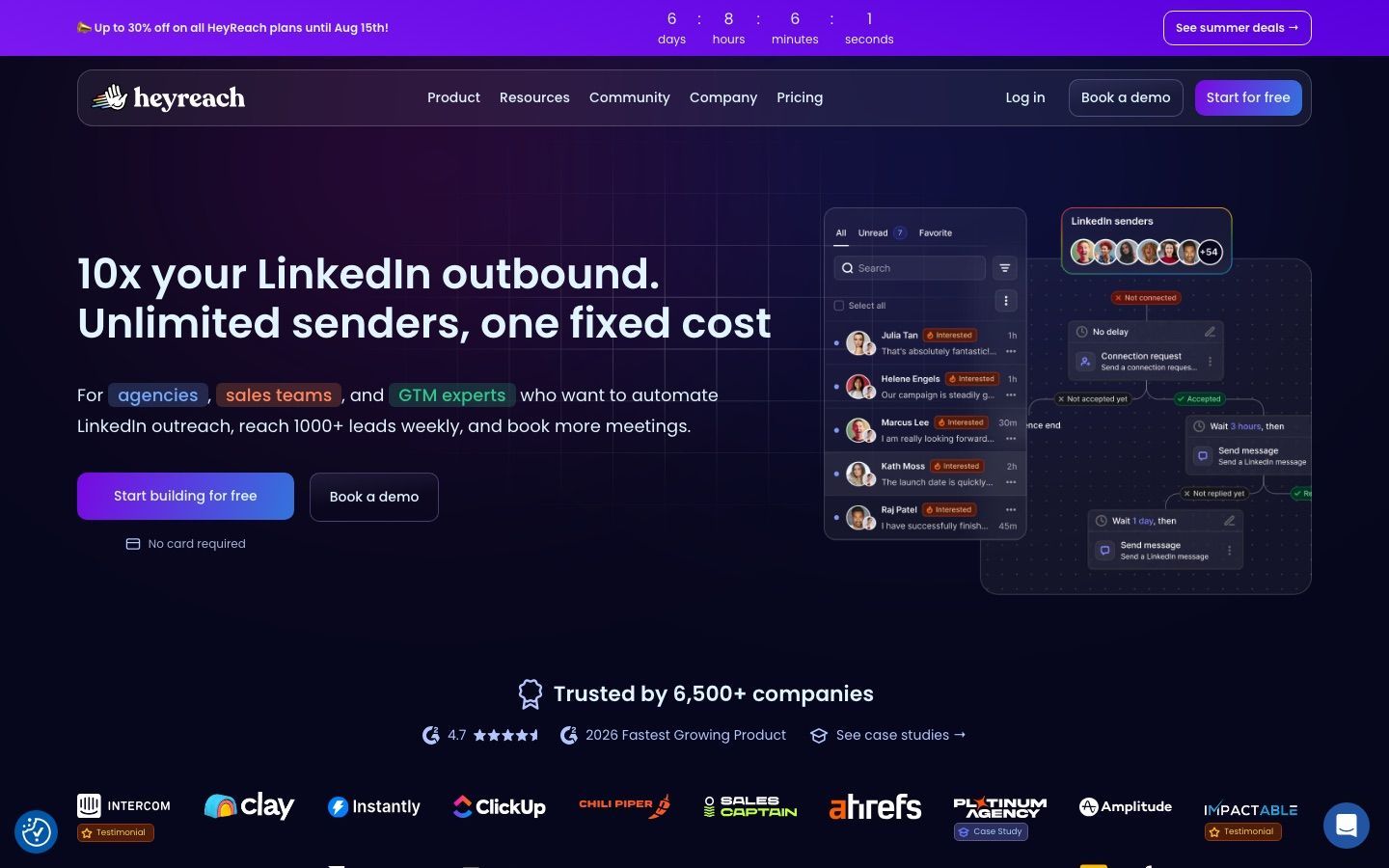
HeyReach belongs to the multi-account end of the LinkedIn automation tools market. The design premise is that a campaign should not belong to one LinkedIn profile. Instead, you connect a pool of accounts, the campaign spreads its daily volume across them, and replies from all of them arrive in a shared inbox that any teammate can work from. Everything else on the feature list, unlimited campaigns, the full set of LinkedIn actions, workspaces and permissions, integrations, is included on every tier, so the plan you choose mainly changes what a sender costs and how many enrichment credits you get.
The billing unit is the sender, meaning one connected LinkedIn account, not the user. A five person agency running three client accounts pays for three senders, and can add a VA, an account manager or a client login without paying more. That is the reason HeyReach turns up on so many agency shortlists: seats are free, accounts are what you buy.
The buyer it fits is therefore quite specific:
- An agency managing several client accounts under one roof, who needs client data kept apart and a whitelabel option.
- An in-house sales team that already runs a handful of LinkedIn accounts and wants one inbox instead of five logins.
- A RevOps or growth engineer who wants campaign events and replies flowing into a CRM or a reporting stack through an API rather than exports.
Who it fits less well is equally clear. A solo rep with one account pays $79 a month for orchestration built for a fleet, and only gets value from the unified inbox and the API if those matter more than the price. A team that wants prospecting data inside the tool will find enrichment credits instead of a database. And a team that wants LinkedIn and email in one sequence, sent from one place, will need a second product.
How much does HeyReach cost in 2026?
HeyReach's pricing is per LinkedIn sender on Growth and flat above that. The figures below were read on heyreach.io/pricing on 24 October 2026 and replace the numbers that circulated earlier in the year.
| Plan | Monthly billing | Annual billing (per month) | Senders | What it adds |
|---|---|---|---|---|
| Growth | $79 per sender | $64 per sender | Priced per account | Unlimited campaigns, every LinkedIn action, unified inbox, multichannel handoffs, 100 enrichment credits per sender, integrations, API, webhooks, MCP server, workspaces and permissions |
| Growth from 10 senders | $59 per sender | $48 per sender | 10 or more | Same feature set, lower unit price |
| Agency, 25 senders | $999 flat | $800 flat | 25 included | Everything in Growth, 1,000 enrichment credits, whitelabel, done for you onboarding, a dedicated Slack channel; you bring your own proxies |
| Agency, 50 senders | $1,399 flat | $1,120 flat | 50 included | The same Agency plan with the 50 sender option selected |
| Unlimited | $2,999 flat | $2,399 flat | 300 seat fair use pool | Everything in the agency tiers, 3,000 enrichment credits, multi-brand whitelabels as a paid add-on, done for you migration, priority support |
Three details on that page are easy to miss. The annual column is a 20 percent reduction on every tier, rounded up to the next dollar on Growth and Agency ($79 becomes $64, not $63.20). The done for you service has no published figure and routes to a custom quote. And an Early stage program offers discounted pricing to companies under $250,000 in annual revenue with fewer than five people who are not yet HeyReach customers, which is worth asking about before paying the list rate on Growth.
The badges on the same page, a "Trusted by 7,000+ companies" line, a 4.7 rating that links to HeyReach's G2 reviews page, and a 2026 Fastest Growing Product award that links to a G2 list, are shown by HeyReach itself. The customer count has no source next to it and we could not open G2 to confirm the rating, so treat them as marketing rather than verified scores.
What does a HeyReach sender pool cost at each size?
Agencies do not buy one sender, they buy a fleet, so the question that matters is where the per-sender rate on Growth and the flat tiers cross. Using only the 24 October 2026 list prices on monthly billing:
| LinkedIn senders | Growth per-sender route | Cheapest HeyReach route | Effective price per sender |
|---|---|---|---|
| 1 | $79 | $79 on Growth | $79 |
| 5 | $395 | $395 on Growth | $79 |
| 10 | $590 at the $59 rate | $590 on Growth | $59 |
| 20 | $1,180 at the $59 rate | $999 on Agency (25 senders), with 5 senders unused | $50 |
| 25 | $1,475 at the $59 rate | $999 on Agency (25 senders) | $40 |
| 50 | $2,950 at the $59 rate | $1,399 on Agency | $28 |
| 300 | not offered per sender at that size | $2,999 on Unlimited, inside the fair use pool | $10 |
Two readings follow from that table. First, the $59 rate only starts at ten senders, so a team with three or four accounts pays the full $79 each, which is one of the higher per-account entry prices in this category. Second, the flat tiers become the cheaper route earlier than their ceilings suggest: from around 17 senders, $999 on the 25 sender Agency plan already undercuts 17 times $59 ($1,003), so an agency growing past the mid teens should model both routes rather than waiting to fill 25 seats.
What does a HeyReach campaign actually do?
A HeyReach campaign is a sequence of LinkedIn steps assigned to a set of senders. The platform rotates volume across every sender in that set, so no single account absorbs the whole daily load, and replies from every sender land in one inbox. Both are available on Growth, not held back for the flat tiers.
The sequence builder combines native LinkedIn actions, conditions and handoffs:
- Native LinkedIn steps: connection request, message, InMail, voice note, find email, plus profile views, follows and post likes.
- Conditions: branch on whether a request was accepted, whether a lead replied and similar states, with waits between steps.
- Handoff blocks: send the lead to a connected Instantly, Smartlead or EmailBison account for the email leg of the sequence.
That third group is the important caveat behind "multichannel outreach" on the plan list. HeyReach's own page frames the email story as working "with native Instantly and Smartlead integrations", which is a candid way of saying LinkedIn is native and email is outsourced. The typical branch is: if the connection is accepted, continue with LinkedIn messages; if it is ignored, push the lead into an email sequence in the connected tool after a set number of days. A reply on either channel pauses or stops the other. SMS and native email are not part of the picture (a voice note step reached every plan in September 2026), so a team that wants every channel in one thread will be reconciling two inboxes and two invoices.
The unified inbox is the part agencies mention most, and for good reason. Once a campaign runs across more accounts than one person can log into in a day, a single place to read and answer replies, with the sender context attached, is the difference between a fleet you can operate and one you cannot.
How does HeyReach work for agencies managing client accounts?
HeyReach's agency positioning is direct: connect as many LinkedIn accounts as the client roster needs and let the platform rotate sending between them. Client data lives in separate workspaces with controlled access, so one client cannot see another's leads, and each LinkedIn account can be connected with the 'Keep it private' inbox setting, which limits tracking to conversations started from HeyReach campaigns and keeps the rest of a client's LinkedIn messages private from the agency operator (the other setting syncs the full inbox, including the past 30 days).
Whitelabeling on the 25 sender tier goes beyond a logo swap. An agency can rebrand the whole product, including its own domain and sign-in page, so clients log into what looks like the agency's platform. Unlimited extends that to multiple brands as a paid add-on, which suits a holding group running several agency labels.
The operational reality for an agency on HeyReach is that the platform handles the sending layer well and leaves two things outside its walls: the prospect data, which comes from Sales Navigator or a vendor, and the email channel, which comes from a separate sending tool. If a client brief includes email, budget for an Instantly, Smartlead or EmailBison seat and the time to keep two systems in step.
What are HeyReach's sending limits and how does rotation apply them?
HeyReach's help center is clearer about limits than its pricing page. Daily limits belong to the LinkedIn account, not the campaign. If a sender is active in several campaigns, its daily allowance is shared proportionally between them: a sender capped at 20 connection requests a day and running in three campaigns gets roughly 20 across all three, not 20 per campaign. The same logic applies inside a single sequence. Each warm-up action (Like Post, View Profile, Follow Profile) has a limit of 40 a day per sender, shared across steps and campaigns, so three Like Post steps get about 13 each, which is why HeyReach advises using each warm-up action once per sender.
On top of those per-account limits sit two automatic freezes:
- Connection requests are capped at 200 per sender per week, and a sender that LinkedIn stops from sending more goes into a Cooldown Mode until the limit resets on Monday (HeyReach's older safety guide still describes a freeze close to 100 a week).
- A sender hitting 200 actions in a day is frozen until the next day.
Both numbers are HeyReach's operating assumptions, not LinkedIn's published rules. LinkedIn confirms that an invitation limit exists without stating the figure or the time window, and operators report sustained volumes of roughly 80 to 100 requests a week on a free account, 100 to 200 on Premium and 150 to 200 on Sales Navigator, with disagreement at the top of each range. HeyReach's help centre is split on the figure: its safety guide (February 2026) describes a freeze close to 100 requests a week, while its connection limits article (August 2026) caps requests at 200 per sender per week, with a default of 25 a day and a maximum of 40. The 200 cap sits near the top of those ranges, so an agency responsible for someone else's account should set its own daily limit nearer the cautious end. Our breakdown of LinkedIn connection limits covers how those ranges are derived.
Rotation itself is not capped by plan. A campaign can carry as many senders as the workspace holds, and on Growth every connected account gets its own dedicated static residential proxy, a fixed IP that is never shared with another account; on Agency and Unlimited you bring your own proxies.
| Mechanism | HeyReach's rule | Effect on a 10 sender campaign |
|---|---|---|
| Daily action limits | Set per LinkedIn account, split proportionally across the campaigns the account runs in | Each of the 10 senders keeps its own limit; adding one to a second campaign divides its allowance instead of doubling it |
| Weekly connection request cap | Up to 200 requests per sender per week, with a Cooldown Mode pause until Monday once LinkedIn blocks more | All 10 send in parallel, and each pauses on its own as it hits its own ceiling |
| Daily action freeze | Automatic pause at 200 actions per sender per day | A sender that spends the morning on views and likes can hit 200 and stop before its messages or InMails go out |
| Proxy | On Growth, one dedicated static residential proxy per account, never shared; on Agency and Unlimited, your own proxies | 10 senders means 10 separate fixed IPs, not one IP rotated across the pool |
Can HeyReach send InMails, and what does it cost?
Yes, with a hard prerequisite: HeyReach only sends InMails from senders that hold a Sales Navigator subscription. Premium and Recruiter accounts cannot send InMails through the platform, and a campaign with an InMail step only launches when its senders have Sales Navigator connected.
Credit handling mirrors LinkedIn's own rules. An InMail to an open profile costs nothing, an InMail to a closed profile costs one credit, the credit comes back if the recipient replies, and replying to an InMail is always free. HeyReach adds its own ceiling of 40 InMails a day per sender on account health grounds, regardless of how many credits the account still holds.
The credit balance itself is LinkedIn's: Sales Navigator Core carries 50 InMail credits a month, credits expire after 90 days, and one is returned when the recipient accepts, declines or responds inside that window. First degree connections and open profiles never consume a credit; LinkedIn also waives the credit for job applicants, but only in Recruiter, which HeyReach does not support for InMail. The full mechanics are in our guide to LinkedIn InMail.
What do HeyReach's enrichment credits actually cover?
HeyReach does not include a searchable prospect database. What it includes is a one-time allocation of enrichment credits: 100 per sender on Growth, 1,000 on the Agency plan and 3,000 on Unlimited, with paid top-up packs that never expire. Those credits run the Find Email step on leads already in a campaign, one credit per verified email found; they cannot be spent on lead lists or through the API. They do not let you search for new people.
Two consequences follow. Every audience starts somewhere else, usually a LinkedIn or Sales Navigator search imported directly or a CSV from a data vendor, so the real cost of a campaign includes whatever that data source charges. And the allowance scales with the plan rather than with how many leads you enrich. Ten Growth senders hold 1,000 credits, the same number the 25 sender tier lists as a flat pool, while Unlimited's 3,000 credits are spread across a fair use pool of up to 300 seats, which means a large Unlimited workspace can run dry faster than a small Growth one. Credit based enrichment is standard in this category, so none of that is a mark against HeyReach specifically, but it is a line item to estimate before comparing sticker prices.
If you are surveying LinkedIn prospecting tools more broadly, the distinction to check on every pricing page is exactly this one: credits that enrich what you already have versus a database that finds what you do not.
Does HeyReach have an API, webhooks and an MCP server?
Yes, and this is HeyReach's strongest card. The API, webhooks and the MCP server are all part of Growth, the entry tier, rather than an upgrade lever. Plenty of competitors reserve developer access for their top plan, so a team paying for two senders getting the same programmatic access as an agency on Unlimited is a genuine differentiator.
The three pieces do different jobs:
- API: pull and push senders, campaigns, leads and enrichment results on demand. This is what an agency uses to build a client facing dashboard outside HeyReach's own interface.
- Webhooks: push events the moment they happen, a reply, an accepted connection, an enrichment completing, so a CRM record or a Slack channel stays current without anyone checking HeyReach.
- MCP server and CLI: the MCP server lets AI agents in Cursor, Claude or any MCP capable app read and act on HeyReach data through tool calls instead of custom code, and HeyReach states it costs nothing extra. The CLI exposes what the dashboard does from a terminal.
Beyond the developer layer, the integration list is broad: Clay, HubSpot, Attio, Breakcold, Zapier, Make, n8n, Pabbly and Slack, plus RB2B and Persana for intent and enrichment. Only HubSpot carries an explicit sync claim on HeyReach's pages; the rest are connectors or automation platform recipes. In practice, a fifty workspace agency will use all three developer pieces at once, while a two sender team will rarely touch the API, but pays nothing extra for it being there.
Is HeyReach safe to use on LinkedIn?
HeyReach's safety story rests on four things covered above: a dedicated static residential proxy per account on Growth (Agency and Unlimited bring their own), per-account daily limits that are shared rather than multiplied across campaigns, a weekly cap of 200 connection requests per sender with a Cooldown Mode pause once LinkedIn pushes back, and a freeze at 200 actions a day. That is a reasonable set of guardrails, though the weekly cap sits near the top of what operators report, so the conservative setting is the daily limit you choose yourself.
It is also worth being precise about what those guardrails do and do not change. Rotation spreads a campaign's volume so no one account carries all of it, which lowers the load per sender. It does not change what LinkedIn tolerates from each individual account, because LinkedIn evaluates every profile on its own pattern, not on the fleet's average. LinkedIn's own help page on account restrictions is the baseline every automation tool sits on top of, and it is LinkedIn, not the vendor, that decides when a restriction triggers and how long it lasts.
For an agency this matters more than for an in-house team, because the account at risk belongs to a client. Before the first campaign goes live, confirm what HeyReach does when a sender hits a limit, receives a checkpoint or gets a warning, and agree with the client on pacing for newly connected accounts. Our guides on whether LinkedIn automation is safe and on what triggers a LinkedIn account restriction cover the patterns to avoid on any platform, HeyReach included. Treat published or assumed limits as a ceiling to stay under, not a daily target, especially in the first weeks on a fresh account.
HeyReach pros and cons
| Where HeyReach is strong | Where HeyReach falls short |
|---|---|
| API, webhooks and an MCP server on every plan, Growth included | $79 per sender below ten senders is among the pricier entry points in the category |
| One inbox for every sender's replies, with client conversations isolated | No prospect database; credits enrich imported leads, they do not source new ones |
| Automatic rotation across an unlimited number of senders per campaign | Email is a handoff to Instantly, Smartlead or EmailBison, not a native step |
| Workspaces, permissions and full whitelabel for agencies | No native SMS or email step |
| Flat tiers at 25, 50 and 300 seats that drop the effective price per sender to $40, $28 and $10 | The flat tiers need a real sender count to pay off; a 12 sender team is still on per-sender pricing |
| Dedicated static residential proxy per account on Growth and automatic freezes and cooldowns | Agency and Unlimited require you to bring your own proxies |
How does HeyReach compare with Cadency?
Cadency runs on the same model, one campaign spread across a pool of LinkedIn senders with one sender per lead and a unified inbox, and differs from HeyReach on three points that decide the fit: how it bills, where email lives, and whether prospect data is inside the product.
Billing. Cadency's Essential plan is $89 a month with 2 LinkedIn senders included and $39 for each additional sender; Small Team is $199 a month with 5 LinkedIn senders included and $39 for each additional sender; Scale is $699 a month with 20 senders included and $25 per additional sender. Annual billing takes 30 percent off, to $62, $139 and $489 a month. Unlimited teammates, unlimited workspaces and the API are on every plan. Every plan is self-serve: Essential starts with a free trial, and Small Team and Scale start without a trial.
Email. Cadency sends email itself, from Google and Microsoft mailboxes with warm-up, rotated inside the same campaign as the LinkedIn steps. Essential and Small Team include 100,000 emails a month and Scale includes 500,000, with upgrades to one million (+$200) and two million (+$500). Mailboxes are unlimited and are not counted as senders. HeyReach reaches email through a connected Instantly, Smartlead or EmailBison account, which is a second subscription and a second inbox.
Data. Cadency has a native B2B database for people and company search and waterfall enrichment across several providers, paid per verified hit, alongside CSV and Sales Navigator imports. HeyReach relies on imported lists and enrichment credits.
Using HeyReach's 24 October 2026 list prices and Cadency's monthly prices, here is what the two cost at typical fleet sizes, before any email tooling on the HeyReach side:
| LinkedIn senders | HeyReach, cheapest route | Cadency, cheapest route | Cheaper on LinkedIn price alone |
|---|---|---|---|
| 1 | $79 on Growth | $89 on Essential (2 senders included) | HeyReach |
| 5 | $395 on Growth | $199 on Small Team | Cadency |
| 10 | $590 on Growth at $59 | $394 on Small Team (5 extra at $39) | Cadency |
| 20 | $999 on Agency (25 senders) | $699 on Scale | Cadency |
| 25 | $999 on Agency (25 senders) | $824 on Scale (5 extra at $25) | Cadency |
| 50 | $1,399 on Agency | $1,449 on Scale (30 extra at $25) | HeyReach |
Read honestly, HeyReach is the cheaper tool for a single sender and again at 50 senders, and its Unlimited tier at $2,999 for a 300 seat pool has no equivalent on Cadency's public price list. Cadency is cheaper across the 5 to 25 sender range where most agencies and sales teams sit, and the gap widens once a HeyReach buyer adds the email platform that Cadency includes.
On the LinkedIn steps themselves, Cadency runs eight: profile visit, connection request, message, InMail, comment on the lead's last post (AI drafted, approved by you), voice note, like and follow, with branching on connected, replied and email found. HeyReach's native list covers connection requests, messages, InMails, voice notes, find email, profile views, follows and post likes, so comments on posts are the visible gap. On safety the two look alike: per-sender ceilings, pacing, a dedicated proxy per sender, checkpoint handling and cloud execution with nothing running from a browser. Cadency's inbox also tracks only conversations started from Cadency, so a rep's private LinkedIn messages stay private, the same boundary HeyReach offers through its 'Keep it private' inbox setting. Cadency can supply vetted ambassador accounts on demand for teams that do not have enough of their own; HeyReach's equivalent is the done for you service, quoted on a call.
Where HeyReach keeps an edge beyond price at the extremes: it ships a CLI next to its MCP server (Cadency has an MCP server on every plan, but no CLI), it has a longer public integration list, and its whitelabel, down to a custom domain and sign-in page, is priced on its pricing page, while Cadency's white label (your brand and your own domain) is scoped on a call. Cadency connects any CRM or ATS through its API and webhooks and does not offer a native CRM sync, which is the same developer first approach HeyReach takes for everything except HubSpot. The side by side with screenshots is in the Cadency vs HeyReach comparison, and the pricing calculator lets you plug in your own sender count. If HeyReach is close but not right, our HeyReach alternatives roundup covers the wider field.
Verdict: should you buy HeyReach in 2026?
HeyReach is a coherent product built around one clear idea, many senders in one campaign with one inbox, and it prices developer access the right way by putting the API, webhooks and MCP server on the cheapest plan. The sending limits and per-account proxies are sensible, the agency features are complete, and the flat tiers bring the effective price per sender down to $40 at 25 senders, $28 at 50 and $10 across a 300 seat pool.
The honest limits are three. Below ten senders you pay $79 per account, which is expensive for what a small team uses. There is no database behind the enrichment credits, so prospect data is a separate budget line. And email is a handoff, so a genuine LinkedIn plus email sequence means a second tool.
Buy HeyReach if you are an agency or multi-account team near the 25, 50 or 300 seat thresholds, you already have a reliable source of prospect data, you either do not need email or already run Instantly, Smartlead or EmailBison, and API level access shapes how you report. Look at Cadency or another combined platform if you sit in the 5 to 25 sender range, want email sent from the same campaign, or want search and enrichment inside the tool rather than bolted on. Either way, read the vendor's help center on limits before a demo, and ask what happens at a freeze, not just what a sender costs.
Frequently asked questions
How much does HeyReach cost per month in 2026?
As read on heyreach.io/pricing on 24 October 2026, HeyReach Growth costs $79 per LinkedIn sender a month, or $64 on yearly billing, and the rate steps down to $59 per sender ($48 on yearly billing) once you run ten or more. The Agency plan is a flat $999 a month for 25 senders ($800 billed yearly) or $1,399 for 50 ($1,120 billed yearly), and Unlimited is $2,999 ($2,399 billed yearly), capped at 300 senders under a fair-use policy. The done for you service is quoted on a call.
Is HeyReach worth the money?
HeyReach is worth it for an agency or sales team that already runs a pool of LinkedIn accounts, sources its own prospect lists and wants API, webhook and MCP access without paying for a top tier. It is a weaker deal for one or two senders, where $79 a month per account buys fleet infrastructure you are not using, and for teams that want email sent natively, since HeyReach hands email to Instantly, Smartlead or EmailBison.
Does HeyReach include API access on the cheapest plan?
Yes. The API, webhooks and the MCP server are part of Growth, the entry plan, and are not reserved for Agency or Unlimited. HeyReach's MCP page states the server costs nothing extra and works with Cursor, Claude and any other MCP capable app, and a CLI makes the dashboard scriptable from a terminal. That makes HeyReach one of the few tools in the category where developer access does not force an upgrade.
What is the difference between HeyReach's 25 sender and 50 sender Agency options?
HeyReach now sells one Agency plan with a sender selector: $999 a month for 25 LinkedIn senders ($800 billed yearly) or $1,399 for 50 ($1,120 billed yearly), as read on 24 October 2026; its help centre still calls the two options Micro agency 25 and Agency 50. The 25 sender tier adds 1,000 enrichment credits, whitelabel branding, done for you onboarding and a dedicated Slack channel on top of Growth. The flat tiers undercut the per-sender rate earlier than their ceilings suggest, the 25 sender Agency option from about 17 senders, though a team running 12 senders is still better off on Growth's $59 rate.
Does HeyReach have a built-in prospect database?
No. HeyReach bundles enrichment credits by plan, 100 per sender on Growth, 1,000 on the 25 sender tier and 3,000 on Unlimited, and those credits enrich leads you have already imported rather than letting you search for new ones. Every audience starts in a LinkedIn or Sales Navigator search, imported directly, or with a separate data vendor as a CSV, so the cost of prospect data sits outside the subscription and should be budgeted separately.
Can HeyReach send emails and LinkedIn messages in the same sequence?
Only through a connected email platform. HeyReach's sequence builder runs connection requests, messages, InMails, voice notes and find email steps natively, then hands a lead to Instantly, Smartlead or EmailBison for the email step, with a reply on either channel pausing the other. That means a true LinkedIn plus email sequence needs a second subscription and a second inbox, and HeyReach lists no native email or SMS step of its own.
Does HeyReach offer a free trial?
Yes. HeyReach's pricing page FAQ states a 14-day free trial with no credit card and up to 3 LinkedIn accounts, and the signup page repeats 'Start your 14-day free trial. No credit card required.' The FAQ adds that a 30-day trial can be requested for the flat plans. HeyReach also lists an Early stage program with discounted pricing for companies under $250,000 in annual revenue with fewer than five people who are not yet customers. Anyone testing before a client launch should know the 14-day trial covers up to 3 LinkedIn accounts and does not convert to a paid plan on its own: a plan has to be selected to keep going when it ends.
Ready to run LinkedIn and email from one engine?
Cadency pools every LinkedIn sender and mailbox into one campaign and one inbox. Essential starts at $89 a month with 2 LinkedIn senders and a free trial.